
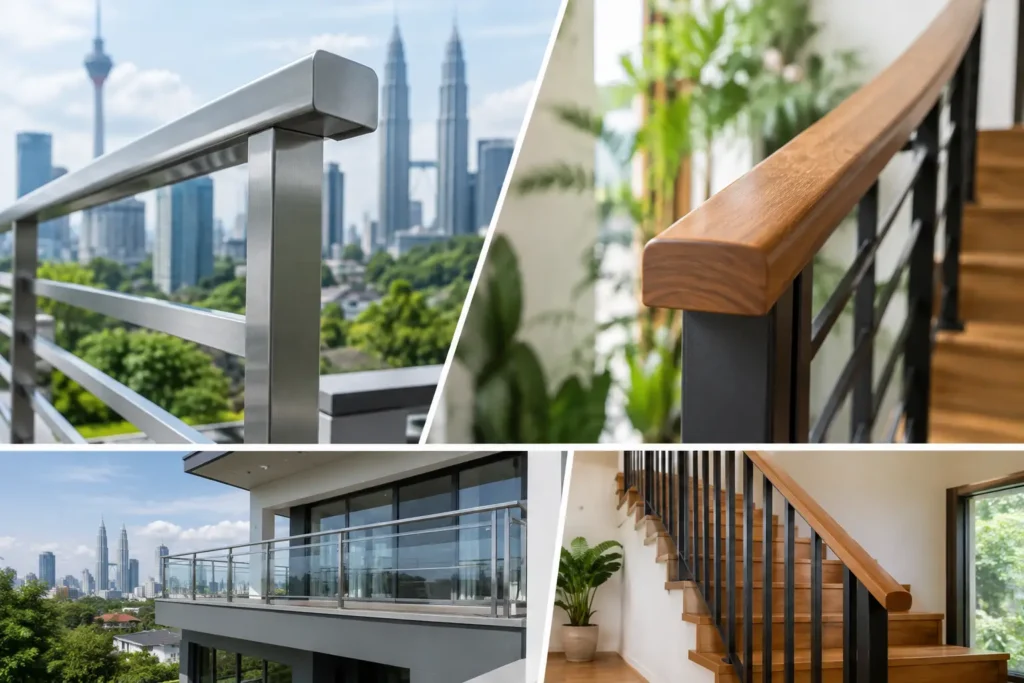
A staircase handrail may look like a finishing detail on a drawing, but on site it takes daily hand contact, sideways force, moisture, and direct afternoon sun. For homeowners deciding between aluminum versus timber handrails, the better choice is not simply about appearance. It comes down to the staircase structure, exposure to Malaysia’s monsoon weather, the desired level of upkeep, and whether the railing must work with glass, steel, or a more traditional interior.
For a covered staircase in a Damansara Heights bungalow, timber can bring warmth that metal cannot imitate. For an external balcony, wet stair landing, or an open void exposed to rain in Puchong, powder-coated aluminum usually gives the more dependable long-term result. The right specification begins with the site condition, not a catalog photo.
Aluminum Versus Timber Handrails in Malaysian Conditions
Malaysia’s heat, humidity, and frequent rain place different pressures on each material. Timber responds to moisture. Depending on the species, grain direction, finishing system, and installation method, it can expand and contract through wet and dry cycles. This movement may open joints, affect alignment, or leave a surface feeling less consistent over time.
A properly fabricated aluminum handrail does not absorb water. That makes it particularly suitable for outdoor staircases, terrace edges, poolside transitions, and glass railings where rainwater can track along the top rail. Powder-coated aluminum also offers a wide choice of colors, from matte black and charcoal to warmer wood-look finishes. It gives a clean architectural line without relying on a natural timber surface to remain stable under weather exposure.
However, aluminum is not automatically the correct answer everywhere. In a dry internal stairwell, a solid timber handrail has a tactile quality that many luxury homes favor. It feels warmer under the hand and can soften a steel staircase structure or a glass balustrade. The trade-off is that timber needs a suitable protective finish and a realistic expectation of periodic surface care, especially around high-contact areas.
Start With the Staircase and Load Path
Handrails are safety components, not decorative strips attached after the main work is complete. Before selecting material, the contractor should understand what supports the handrail and where force transfers when someone leans, pulls, or braces against it.
On a structural steel staircase, the handrail posts may be welded to stringers, side plates, or dedicated base plates. On concrete stairs, fixing positions, embedment, edge distance, and the condition of the substrate need review before installation. A glass railing introduces another layer of coordination: glass thickness, panel spacing, clamps or base shoes, glass dampening gaskets, and the continuity of the top rail must all work together.
Aluminum is relatively light, which can reduce loading on a finished staircase edge and suits slim-profile railing designs. Its sections still need correct sizing. A thin-looking top rail may be attractive, but excessive span between supports can cause movement that users notice immediately. Corner joints, end returns, brackets, and concealed reinforcement deserve as much attention as the visible finish.
Timber handrails need similarly careful fixing. Long lengths require allowance for natural movement, and joins must be positioned and detailed so they remain neat. Where a timber rail sits above a steel or glass balustrade, the supporting bracket system should prevent local stress points and keep the line straight across landings and turns.
The material is only one part of the railing
A high-quality installation depends on measured fabrication and controlled site work. Stair pitch, wall condition, landing levels, and final floor finishes affect handrail height and alignment. A rail fabricated from preliminary drawings alone can look wrong once tile thickness, stone nosing, or timber treads are installed.
For that reason, site measurement should happen after the key staircase dimensions are confirmed. This is especially relevant for spiral staircases, where each tread rotation changes the handrail geometry, and for curved or double-height staircases where minor alignment errors become very visible.
Design Direction: Warm Timber or Crisp Aluminum
Timber suits interiors where the handrail is intended to be a feature. It pairs naturally with timber treads, stone, textured wall finishes, and hot-forge solid wrought iron balusters. In a more classical bungalow, a timber top rail can make ornamental ironwork feel refined rather than heavy.
Aluminum is often the stronger design fit for contemporary homes and commercial spaces. Black powder-coated aluminum works well with slim-profile aluminum glazing, clear glass panels, gray porcelain tile, and steel-framed stair structures. It can also be formed into straightforward geometric profiles that suit modern terraces, offices, shopfront mezzanines, and apartment common areas.
For clients who want the visual warmth of wood with better weather resistance, wood-look powder coating on aluminum can be considered. It should be selected with realistic expectations: it creates a consistent architectural finish, not the individual grain variation of natural timber. In a modern project, that consistency can be an advantage.
Color selection matters outdoors. Very dark aluminum rails under full sun can become hot to touch, while pale colors may show dirt more readily near high-traffic entrances. A covered porch in Bangsar has different exposure from an open rooftop stair in Cyberjaya. Reviewing the actual orientation of the staircase is more useful than choosing a color only from a small sample.
Durability, Security, and Day-to-Day Use
Aluminum’s key advantage is its resistance to rot and moisture-related deterioration. With a quality powder-coated finish and correctly detailed connections, it is a practical choice for wet and exposed locations. Drainage still matters. Water should not be trapped inside hollow sections or against fixing points. At external railing bases, sensible gaps, sealed interfaces where required, and proper drainage paths help prevent staining and water retention.
Timber requires more attention in these same areas. Even premium timber can suffer if water repeatedly sits at an end grain, joint, or underside. It is more appropriate where the staircase is protected from direct rain and where the owner values the material enough to maintain its finish over time.
Security is primarily determined by the full railing system, not whether the top rail is aluminum or timber. Post spacing, infill design, glass specification, anchors, weld quality, and bracket fixing all contribute to the finished performance. For homes with children, elderly family members, or frequent guests, a comfortable grip profile and continuous handrail line are practical priorities. Sharp transitions or poorly positioned brackets can make an otherwise attractive railing less safe to use.
For commercial work, traffic volume changes the decision. A stair serving an office mezzanine floor, retail unit, or industrial platform receives repeated contact from many users. Aluminum handrails can provide a consistent, durable finish with lower concern about surface wear from moisture and cleaning. Structural steel framing and railing supports must still be engineered and fabricated for the intended use, rather than treated as light decorative work.
Cost Depends on the Full Fabrication Scope
Comparing material alone rarely produces a useful project decision. An aluminum handrail may involve extruded profiles, powder coating, custom brackets, welding or mechanical connections, and site installation. A timber handrail may involve material selection, shaping, staining or clear finishing, specialized joinery, and careful fitting to the balustrade below.
The project cost is influenced by stair length, straight or curved geometry, the number of landings, wall-mounted versus freestanding details, glass or metal infill, access conditions, and the amount of custom fabrication needed. A straight internal wall handrail is very different from a double-height glass staircase with a continuous aluminum top rail.
For architects and homeowners, the practical question is not which material is universally better. Ask which material will remain appropriate for the exact location, visual concept, and level of use five years from now.
FAQs
Is aluminum suitable for an indoor staircase handrail?
Yes. Aluminum is suitable indoors, particularly for modern staircases using glass panels, steel stringers, or clean minimal detailing. Powder-coated finishes provide a broad range of colors and can coordinate with aluminum doors, windows, and other glazing elements.
Can timber handrails be used outdoors?
They can, but outdoor exposure demands careful species selection, finishing, drainage detailing, and ongoing surface care. For staircases exposed to rain and strong sun, aluminum is generally the more practical option.
Can aluminum handrails be combined with glass railings?
Yes. Aluminum top rails can be fabricated for glass railing systems, provided the glass specification, gaskets, clamps or base channel, support spacing, and fixing method are coordinated as one complete assembly.
Does Home Alloy Design & Engineering Work fabricate custom handrails?
Home Alloy Design & Engineering Work provides new custom fabrication, direct supply, and turnkey installation for aluminum, steel, glass, and wrought-iron railing systems from Puchong, Selangor. Each staircase should be measured and reviewed according to its structure, finishes, access, and intended use.
A handrail should feel natural in the hand, follow the staircase without uneven lines, and suit the building long after the renovation dust has cleared. Send your project location, measurements, photos, drawings, and required items through the WhatsApp widget, and the team will review the requirements and advise on the next step.