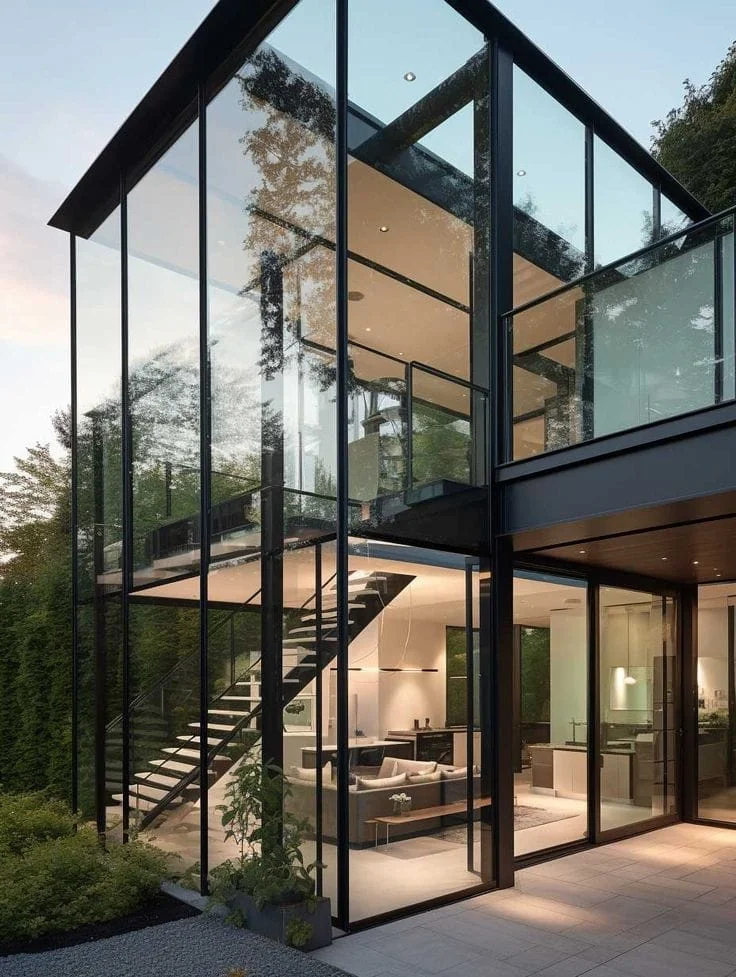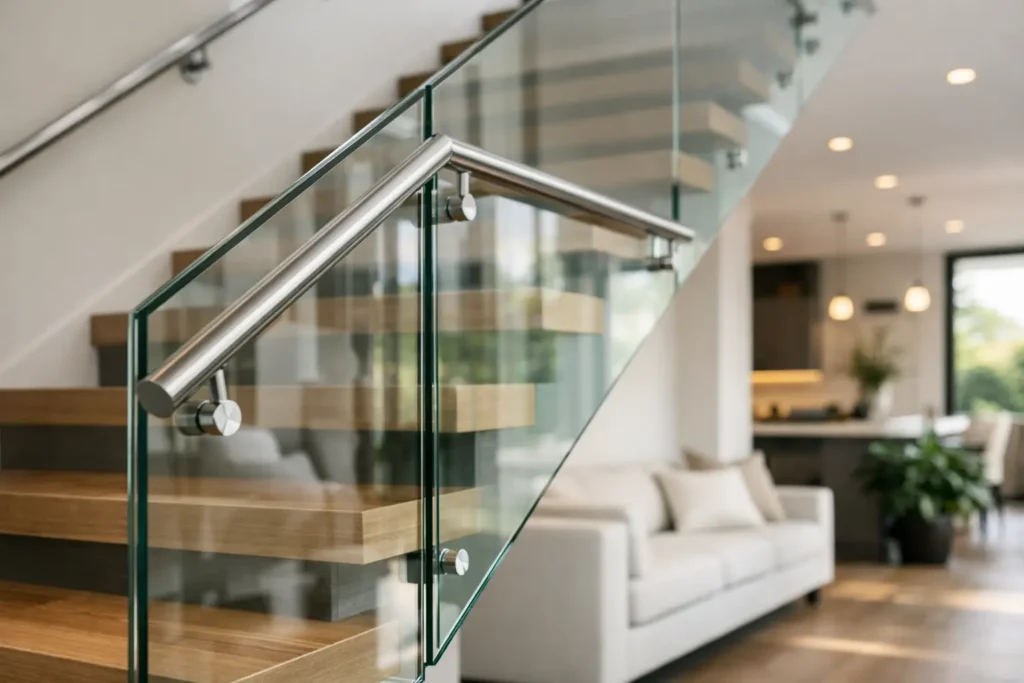
A staircase often sits at the visual center of a home, double-volume foyer, office, or retail space. A glass staircase railing keeps that focal point open rather than breaking it up with heavy bars, walls, or bulky timber balusters. When it is correctly specified and professionally installed, it delivers a clean architectural line while providing the dependable edge protection a stair requires.
The result is not simply “more glass.” A successful railing system is a coordinated piece of fabrication work: the right safety glass, secure fixings, properly engineered base support, carefully aligned hardware, and finishing details that suit the space. For homeowners and project teams, those decisions determine whether the railing feels genuinely premium and built to last.
What Glass Railings Change in a Stairwell
Traditional stair railings define a boundary with visible vertical members. Glass provides that same function while allowing the eye to travel through the stairwell. This is particularly valuable in narrow terraces, split-level homes, and compact commercial interiors, where every sightline affects how spacious the room feels.
Natural light also moves more freely across the floor plan. A stair beside a window, skylight, or open living area can remain bright instead of becoming a dark architectural void. In contemporary interiors with stone flooring, timber treads, steel stringers, or slim aluminum frames, clear glass lets each material remain visible without competing for attention.
There is a practical advantage as well. Glass panels create a continuous barrier, which can be preferable for households with young children or pets compared with widely spaced balusters. The design must still be detailed for its specific use, but the clean, enclosed face of the panel is one reason this system remains a strong choice for modern residences and public-facing spaces.
Choosing a Glass Staircase Railing System
The best configuration depends on the stair structure, wall and floor construction, available edge space, intended handrail, and the visual weight the project can carry. A made-to-order approach matters because stair angles, landing conditions, and substrate strength vary from one site to another.
Frameless Base-Shoe Systems
A frameless system sets the glass into a continuous aluminum base shoe or channel, usually fixed along the stair edge or landing slab. Once installed, the channel can be concealed with matching cover trims, leaving the glass as the dominant visual element.
This approach creates the lightest appearance and suits high-end contemporary homes, show units, offices, and retail interiors. It also demands accurate setting-out. The base channel, anchors, and concrete or steel support beneath it must be planned before installation, not treated as an afterthought once tiling and finishes are complete.
Post-Supported Glass Railings
Stainless steel, powder-coated steel, or aluminum posts can support individual glass panels with clamps. This system introduces visible structure, but it can be an intelligent solution where the slab edge is limited, site conditions are less uniform, or the project needs a more industrial design language.
Posts also offer finish flexibility. Matte black works well with steel stair stringers and dark timber, while brushed stainless steel gives a refined, contemporary look. The key is proportion: undersized posts can look weak, while overly heavy posts can defeat the openness that makes glass appealing.
Side-Mounted or Fascia-Fixed Systems
Where stair width is limited, fixing the railing to the outer face of the stair stringer or concrete slab can preserve more usable tread width. Side-mounted glass can look exceptionally clean, especially on floating stairs, but it requires a capable supporting structure and carefully selected brackets or channels.
This is a detail that should be coordinated early with the staircase fabricator, contractor, and interior designer. Mounting points, cladding thicknesses, waterproofing at external areas, and access for installation all need to be resolved before fabrication begins.
Glass Selection Is a Safety Decision
Not all architectural glass is suitable for a railing. Stair applications require safety glass selected for impact resistance, breakage performance, panel size, fixing method, and applicable project requirements. Tempered glass is commonly used because it is stronger than ordinary annealed glass and breaks into smaller fragments if failure occurs.
Laminated safety glass adds another layer of protection. It consists of two or more glass layers bonded with an interlayer, helping the panel retain its form if one layer breaks. For many railing applications, laminated tempered glass is the preferred premium specification because it combines strength with better post-breakage retention.
Glass thickness cannot be chosen by appearance alone. A thick-looking panel is not automatically the correct panel. Its performance depends on unsupported spans, fixing locations, panel height, edge conditions, handrail support, wind exposure for external stairs, and how people will use the area. A professional fabricator should assess the complete system rather than supplying glass as an isolated component.
Clear glass remains the most popular choice because it maximizes light and visual space. Tinted, frosted, gray, or patterned glass may suit projects requiring more privacy or a stronger design statement. Frosted finishes are useful where a stair faces a neighbor, bathroom zone, or office workspace, though they naturally reduce the transparent, open effect.
Hardware Defines the Finish
The hardware around a glass railing is not a minor accessory. It is the connection between a beautiful panel and a secure structural installation. Quality clamps, channels, spigots, brackets, gaskets, and anchors must be chosen for the glass type and the environment.
For interior projects, stainless steel fittings offer clean lines and strong corrosion resistance. For outdoor or semi-exposed conditions in Malaysia’s humid, tropical climate, material grade and finish become even more critical. Poor-quality hardware can stain, corrode, loosen, or lose its appearance long before the glass itself shows wear.
A handrail is another important decision. Some frameless systems are designed to retain their minimal look without a visible top rail, subject to engineering and application requirements. Others use a slim stainless steel, aluminum, timber, or powder-coated handrail for added support and a more comfortable grip. A handrail can also tie the railing visually to the front gate, balcony railing, window frames, or steel staircase structure.
Precision Installation Makes the Difference
Glass reveals mistakes. Uneven gaps, crooked panel lines, mismatched hardware levels, and poor silicone work are immediately visible, especially in a bright stairwell. That is why site measurement and installation discipline are as valuable as the panel material itself.
Before fabrication, installers should confirm the finished floor level, stair pitch, nosing profile, slab edge condition, wall offsets, and structural fixing zones. On renovation projects, the actual site can differ from original drawings. Measuring after key finishes are in place helps avoid panels that do not follow the stair accurately.
During installation, each panel needs controlled alignment so the top line reads cleanly from the lower floor and upper landing. Expansion tolerances, glass-to-metal isolation, drainage where relevant, and correct sealant selection also protect the system over time. A railing should never depend on decorative silicone alone for its structural security.
For projects that combine a steel staircase, aluminum doors, skylights, or interior partitions, using one specialist team can improve coordination. Home Alloy Design can fabricate and install interconnected steel, aluminum, glass, and railing elements as a cohesive package, reducing handover gaps between separate trades.
Maintenance Without the Myths
Glass stair railings are easier to maintain than many people expect. Routine dusting and cleaning with a soft microfiber cloth, clean water, and a suitable non-abrasive glass cleaner will keep panels clear. Avoid harsh scouring pads or cleaners that can mark coated metal trims and stainless steel finishes.
Fingerprints are more noticeable on clear glass, particularly beside frequently used landings. That is a visual trade-off, not a performance problem. Homes with children, active offices, or busy commercial premises may benefit from a regular cleaning routine or lightly tinted glass that hides marks more effectively.
Hardware should be inspected periodically, particularly on external stairs or balconies. Check for loose fittings, staining, damaged seals, or movement at the base. Early attention to a small issue is far less disruptive than waiting until moisture or repeated use affects the installation.
Plan the Railing as Part of the Whole Project
A glass railing budget should account for more than the glass panel. The total scope may include site measurement, shop drawings, safety-glass specification, custom cutting and edge finishing, brackets or base channels, structural anchors, handrails, delivery, lifting access, and professional installation. Complex stair geometry, curved landings, side mounting, and concealed channels generally require more fabrication and site work than straightforward post-supported panels.
The right question is not whether a railing is the lowest-cost option. It is whether the selected system suits the structure, gives the desired finish, and will remain secure and attractive after years of use. Saving on glass quality, anchoring, or installation can compromise the very qualities that make the feature valuable.
If you are planning a renovation or new build in Puchong, Subang Jaya, Kuala Lumpur, or the wider Klang Valley, bring the stair drawings, reference images, and finish selections into the discussion early. A well-planned glass railing gives the staircase room to breathe, while the engineering beneath it ensures that open look remains confidently secure.