
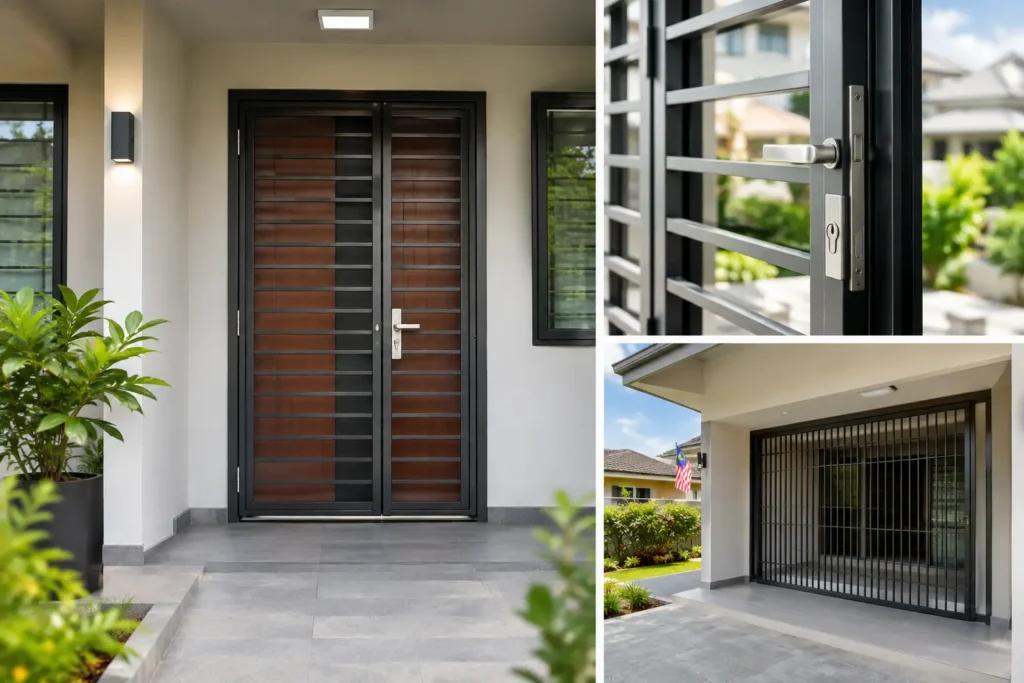
A front entry facing driving rain, strong afternoon sun, and a fully exposed porch needs more than a decorative barrier. The right secure door grille styles must protect the opening without making the entrance feel dark, boxed in, or unsuitable for the home’s architecture. For bungalows in Puchong, TTDI, Bangsar, and Damansara Heights, that decision usually comes down to material thickness, locking layout, sightlines, ventilation, and the way the grille connects to the wall or door frame.
A well-fabricated grille is part of the entrance system, not an afterthought mounted over it. Its design has to work with the main gate, aluminum doors, glazing, porch roof, and daily access pattern of the household.
What Makes a Door Grille Secure?
Security starts behind the pattern. A dense ornamental design may look protective, but it cannot compensate for undersized sections, weak welds, poor anchoring, or a lock positioned where it can be reached from outside.
For a new custom fabrication, the frame carries the main forces into the surrounding structure. The vertical members, horizontal rails, hinges, lock box, and fixing points must act as one assembly. On double-leaf grille doors, the inactive leaf also needs a positive top and bottom fastening arrangement so the meeting line does not become the weak point.
Material selection depends on exposure and design intent. Hot-forge solid wrought iron gives substantial weight and depth for classic entrances and grand porch openings. Mild steel hollow sections can suit contemporary geometric designs when the section size, internal bracing, and welding are properly specified. Grade 304 stainless steel is useful where a cleaner metallic finish is required, although the design should still avoid trapping rainwater and dirt at joints.
The finish matters in Malaysia’s humid climate. Proper surface preparation and a suitable coating system protect fabricated steel from moisture, especially around welded areas, lower rails, and locations exposed to monsoon splashback. Drainage at the entrance should direct water away from the threshold rather than allowing it to sit against the bottom of the grille frame.
Secure Door Grille Styles That Suit Different Homes
Hot-forge wrought iron for classic and luxury entrances
Hot-forge solid wrought iron suits landed homes with traditional, colonial, European-inspired, or palace-style detailing. Scrolls, forged leaves, twisted bars, and hand-shaped elements create visual depth that hollow-section work cannot fully replicate. It is particularly effective at a main entrance where the grille needs to relate to a wrought iron gate, balcony railing, or grand staircase railing.
The trade-off is weight. A large hot-forge door requires hinges, posts, and wall fixing points sized for the load. If the opening is wide, the design may need a fixed side panel, a center support strategy, or a different leaf arrangement to keep alignment stable over time. Heavy ornament should be concentrated where it supports the composition, not added indiscriminately to every part of the panel.
Modern geometric steel grilles
Straight-line grilles remain a strong option for contemporary homes in Cyberjaya, Putrajaya, and newer Puchong developments. Vertical bars, offset rectangles, slim grids, and framed box patterns offer privacy and controlled visibility while complementing slim-profile aluminum glazing.
The spacing requires careful thought. Wider gaps improve the view and air movement, but reduce the protective effect and may allow access to internal handles. Very tight spacing can make a foyer feel closed off. A practical design often uses vertical members at the outer zone, with a denser pattern near locks or reachable glazed panels.
This style also works well with powder-coated aluminum doors and windows. Matching or deliberately contrasting the grille finish with the aluminum frame color creates a cleaner facade than treating every component as a separate item.
Laser-cut privacy screens with a structural frame
Laser-cut panels can produce a more architectural entrance, from restrained linear motifs to custom geometric patterns. They are useful where privacy is needed at a side entry, covered porch, or foyer-facing door, but the owner still wants daylight and a designed facade.
A laser-cut panel must be supported by a proper perimeter frame. The cut pattern removes material, so the remaining panel needs enough stiffness to resist flexing and vibration. Large openings may need intermediate support, particularly where wind exposure is higher or the panel functions as an operable door rather than a fixed screen.
Pattern selection should respond to viewing angles. A design that looks sufficiently private when viewed straight on may expose more of the interior from the driveway or neighboring side boundary. This is worth reviewing during the drawing stage, along with handle position, lock access, and emergency egress requirements.
Grilles integrated with glass and aluminum doors
For homes that want an open, light-filled entry, a grille can sit in front of or within a coordinated aluminum and glass door arrangement. Clear or tinted glazing keeps out rain and dust, while the grille provides the protective layer. This is often more practical than relying on a grille alone when the entrance faces frequent wind-driven rain.
The components should be detailed as a complete system. Glass dampening gaskets, proper glazing support, threshold drainage, and monsoon drip channels all affect long-term performance. Where an exterior grille is installed before a sliding or casement door, there must be enough clearance for operation, cleaning, and multi-point security locking.
Design Details That Change Daily Use
A secure grille should not turn the front entrance into an awkward sequence of keys, locks, and narrow clearances. The swing direction needs to suit the porch layout, vehicle access, and the location of the main aluminum door. At narrow landings, an inward-opening grille may be the better solution. At other entries, outward opening can preserve internal circulation, provided the porch has sufficient clear space.
Locking should be positioned away from large openings in the grille pattern. A secure lock box, protected latch area, and correctly aligned strike plate are more meaningful than decorative hardware alone. For doors used as a primary daily entry, multi-point security locking can provide more consistent engagement along the frame than a single basic latch.
Ventilation is another common requirement. A grille allows the main door to remain open for airflow, but only when privacy, weather exposure, and insect control have been considered. Covered entrances with ACP awnings or PU metal deck roofing have different wind and rain conditions from fully exposed doorways. The opening should be assessed on site rather than copied from a photo of another house.
Fabrication and Installation Are Part of the Specification
A good design can still underperform if the site measurement or installation is careless. Existing columns may not be plumb, tiled porch floors may have uneven falls, and walls may contain finishes that cannot take the intended anchor loading. These conditions affect frame sizing, shim locations, fixing methods, and final door alignment.
For new custom work, fabrication should follow confirmed site dimensions and approved design details. The team needs to check the opening width and height, wall condition, floor level, hinge clearance, roof overhang, drainage path, and relationship to adjoining gates or glazing. Welds should be cleaned and finished properly before coating, while moving parts must be aligned during installation so the leaf closes without dragging or twisting.
Home Alloy Design & Engineering Work provides custom fabrication, direct supply, and turnkey installation for door grilles, wrought iron gates, aluminum glazing, structural steel, and related architectural metalwork from Puchong, Selangor. For a residence or commercial entry, a coordinated package often produces a stronger result than appointing separate fabricators for each element.
FAQs About Secure Door Grille Styles
Which material is best for a secure door grille?
There is no single best material for every opening. Hot-forge solid wrought iron suits decorative, high-presence entrances; fabricated steel sections suit modern layouts; and grade 304 stainless steel suits selected contemporary details. The frame, locking arrangement, weld quality, coating, and site fixing are as important as the base material.
Can a laser-cut grille door provide real security?
Yes, when the panel is designed with suitable thickness, supported by a properly sized structural frame, and installed with secure hinges, locks, and anchors. The cut pattern must not leave overly large openings near handles, locking points, or accessible glazing.
Do large wrought iron grille doors need structural support?
They may. Heavy or wide leaves place significant load on hinges, posts, and the supporting wall or structural steel framing. Site conditions determine whether reinforced posts, additional bracing, or a revised door configuration is needed.
What affects the cost of a custom door grille?
The main factors are opening size, material type, section thickness, pattern complexity, hot-forge ornament, hardware, coating finish, glazing coordination, site access, and installation requirements. A site review and confirmed drawing are needed before final fabrication details can be established.
Which areas do you serve for new custom grille installation?
Home Alloy serves Puchong, Selangor, Kuala Lumpur, and surrounding areas including Subang Jaya, Shah Alam, Petaling Jaya, Putrajaya, Cyberjaya, Kajang, Seri Kembangan, Cheras, TTDI, and Bangsar for new fabrication, supply, and professional installation.
Bring photos, opening measurements, and any architectural drawings to the discussion. Send your project details on WhatsApp and our team will review the requirements and advise on the next step.