
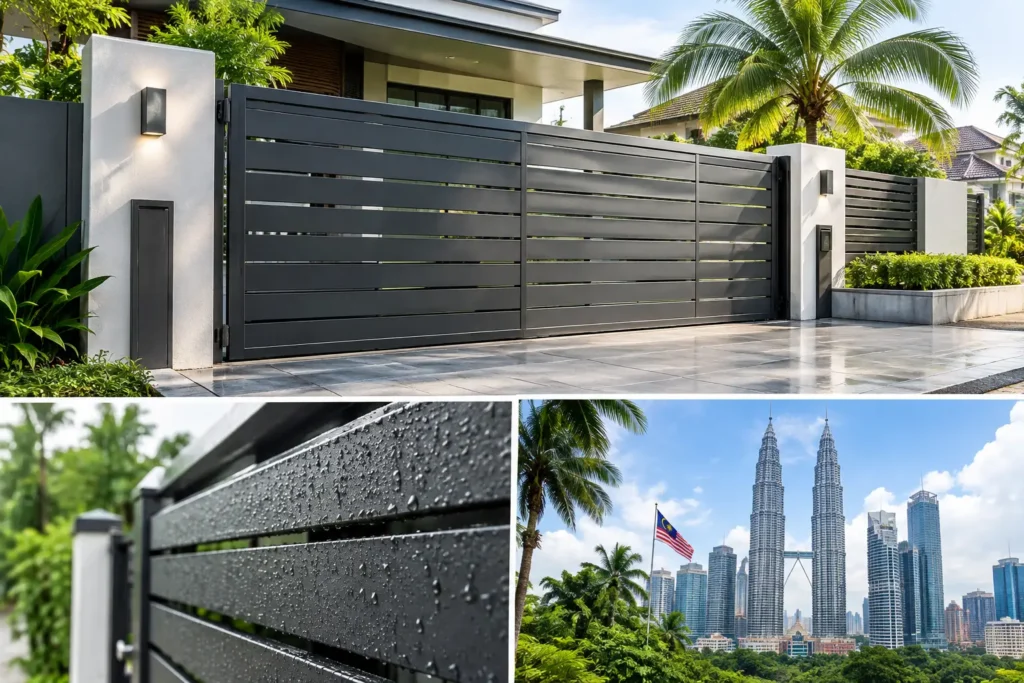
A gate can look excellent at handover, then face months of hard sun, wind-driven rain, and moisture trapped around its lower rails. That is why gate finishes Malaysia property owners select should be treated as part of the fabrication specification, not an afterthought. The finish must suit the metal, the gate design, the exposure of the frontage, and the level of detailing expected from a bungalow entrance, terrace home, commercial lot, or guarded development.
For a property in Puchong, Bangsar, TTDI, or Putrajaya, a main gate is both a security barrier and the first architectural surface visitors see. Its coating affects color retention, corrosion resistance, cleaning needs, and the visual weight of the whole facade. A well-specified finish also supports the gate’s engineering: welds, drainage points, hinges, track alignment, and concealed structural members all need to be considered before the final coating is applied.
Why gate finishes in Malaysia need real weather planning
Malaysia’s climate is demanding on exterior metalwork. High UV exposure can fade unsuitable coatings, while repeated wet-dry cycles can stress corners, weld zones, and horizontal ledges where water settles. In dense neighborhoods, dust, traffic residue, and landscaping chemicals add another layer of exposure. A finish that looks smooth in a sample board may not perform the same way on a large fabricated gate with decorative cutouts, layered frames, and moving components.
The first decision is not simply black, bronze, gray, or white. It is whether the substrate and finishing system work together. Aluminum, mild steel, hot-forge wrought iron, and stainless steel each call for different fabrication and preparation methods. The best result comes from planning the gate structure, infill pattern, fixing points, and surface finish as one coordinated package.
Drainage is particularly important. Bottom rails should not become water traps, and a swing gate must be aligned so its leaves close correctly without scuffing the finished surface. For sliding and trackless gate systems, wheel, guide, motor, and structural support positions must be finalized before fabrication. Trying to alter finished metalwork on site can compromise both appearance and corrosion protection.
Powder-coated aluminum for clean modern facades
Powder-coated aluminum is a strong choice for contemporary homes using slim-profile aluminum glazing, aluminum louvers, glass railings, or ACP awnings. It gives the gate a clean, uniform appearance and can visually match nearby aluminum doors, windows, or facade elements.
Matte black remains popular because it frames landscaping and stone finishes without competing with them. Charcoal gray, textured dark bronze, and muted champagne tones can also work well for homes in Desa ParkCity, Cyberjaya, and Damansara Heights where the architecture relies on glass, concrete, timber-look finishes, and controlled lines.
The practical advantage is consistency. A properly fabricated aluminum gate can carry a finish that complements adjacent aluminum systems, making the frontage feel intentional rather than assembled from separate products. Textured powder-coat surfaces are often useful where homeowners want a less reflective appearance and fewer visible handling marks.
That said, aluminum is not automatically the right answer for every gate. Large openings and solid privacy panels require suitable member sizing, internal reinforcement, and careful consideration of wind loading. A gate leaf that is too flexible can affect alignment over time, regardless of the finish quality. The frame must be engineered to carry its own weight and resist movement at hinges or sliding supports.
When aluminum is the better fit
Aluminum works especially well for lighter modern gate designs, laser-cut privacy panels, horizontal slat compositions, and facades where the gate must coordinate with glazing and aluminum cladding. It is also a sensible material for projects where reduced visual bulk matters. Final suitability still depends on opening width, gate height, infill density, and the supporting columns or steel framing.
Hot-forge wrought iron for depth and architectural character
A hot-forge solid wrought iron gate has a different presence. Its appeal lies in formed bars, scrollwork, hand-shaped details, and deeper sections that suit grand bungalow entrances, classic facades, and ornamental boundary designs. For properties in Bukit Tunku or established parts of Petaling Jaya, wrought iron can provide the substance and formality that a lightweight minimalist gate may not deliver.
The finish should support that character rather than flatten it. Dark textured coatings, black, deep brown, and selected bronze tones can emphasize forged profiles and decorative depth. Where a design combines hot-forge components with laser-cut panels or cast alloy grilles, the finish should be selected to keep the different elements visually balanced.
Fabrication quality matters before any coating begins. Welds need to be cleanly finished, joints properly aligned, and ornamental sections securely fixed into the main structural frame. A heavy gate also needs appropriately sized posts, hinges, bracing, and foundations. The load path runs from the gate leaf through the hinge or sliding assembly into the supporting structure. Decorative work cannot compensate for undersized steel or weak fixing.
For gates with exposed steelwork, details should avoid long unprotected horizontal surfaces and enclosed cavities that can retain moisture. Good fabrication creates sensible water run-off points and access for proper finishing around joints. These are small decisions on paper, but they are highly visible after years of monsoon exposure.
Stainless steel accents and PVD-coated features
Some entrance designs use stainless steel selectively rather than building the entire gate from it. Grade 304 stainless steel can be applied as trims, feature strips, handles, house-number panels, or decorative screens. PVD-coated stainless steel adds richer tones such as champagne, bronze, or dark metallic finishes that suit modern luxury facades.
This approach works best when used with restraint. A polished or highly reflective finish can dominate a frontage under strong sunlight, while brushed textures often sit more comfortably beside stone, timber, and dark powder-coated metal. The gate should still have a clear structural material underneath. Stainless detailing is a design feature, not a substitute for proper frame sizing or corrosion-conscious fabrication.
Choosing a finish by gate design, not color alone
The same finish can feel completely different depending on the design. A full-height privacy gate absorbs more light and can appear heavier than an open grille gate. Laser-cut panels create shadow and depth, so a matte finish often reads better than a glossy one. Ornamental ironwork benefits from coatings that reveal its formed details instead of making every surface look flat.
Consider the relationship between the gate and its surroundings. A home with black slim-profile aluminum sliding doors may benefit from a closely related gate finish, but an exact match is not always necessary. Contrast can be more effective when it is controlled. For example, a charcoal gate can frame warm stone columns, while bronze PVD accents can relate to lighting fixtures or a feature door.
Security should remain central to the specification. Visual openness does not mean sacrificing strength. The frame, infill spacing, multi-point security locking where applicable, hinge arrangement, and gate operating system should be selected around the site layout and access requirements. A beautifully finished gate that sags, drags, or closes poorly is not a finished project.
Fabrication and installation determine the final result
A premium finish cannot hide poor preparation. Before coating, fabricated sections need proper cleaning, surface preparation, and inspection. Edges, cutouts, weld zones, and connection points deserve attention because they are common areas for finish failure when workmanship is rushed.
Installation also affects long-term appearance. Gates must be set out accurately against actual site levels, column positions, driveway falls, and drainage paths. At homes in Shah Alam or Subang Jaya, a sloping driveway may change the gate configuration needed. At a commercial site, delivery access and operational clearance may determine whether sliding leaves, folding sections, or another arrangement is more appropriate.
Home Alloy Design & Engineering Work provides new custom gate fabrication, direct supply, and professional installation from its Puchong workshop base. The advantage of a design-to-installation approach is coordination: the gate design, steel frame, decorative panel work, finish selection, and site fixing can be reviewed as one scope rather than handled as disconnected items.
FAQs about gate finishes Malaysia
Which gate finish lasts best in Malaysian weather?
There is no single answer for every property. A properly specified powder-coated aluminum finish suits many modern gates, while coated hot-forge wrought iron is well suited to heavier ornamental designs. Performance depends on material selection, surface preparation, drainage detailing, and the gate’s exposure to sun and rain.
What affects a custom gate quotation?
The main factors are the gate opening, design complexity, material type, infill style, structural framing, operating configuration, finish, site access, and installation requirements. A solid privacy gate and an open ornamental gate may have very different fabrication and support needs even at the same width.
Can hot-forge wrought iron be used for a modern home?
Yes. Hot-forge wrought iron does not need to be limited to traditional scrollwork. It can be incorporated into cleaner linear patterns, custom grilles, and feature panels, provided the design remains proportionate to the facade.
Does a gate need structural steel support?
It depends on the size, weight, configuration, and supporting conditions. Large or heavy leaves may require structural steel framing, reinforced posts, suitable bracing, and properly designed foundations to maintain alignment and safe operation.
For a gate that carries the right finish as well as the right structure, send your project location, measurements, photos, drawings, and required items on WhatsApp. Our team will review the requirements and advise on the next step.