
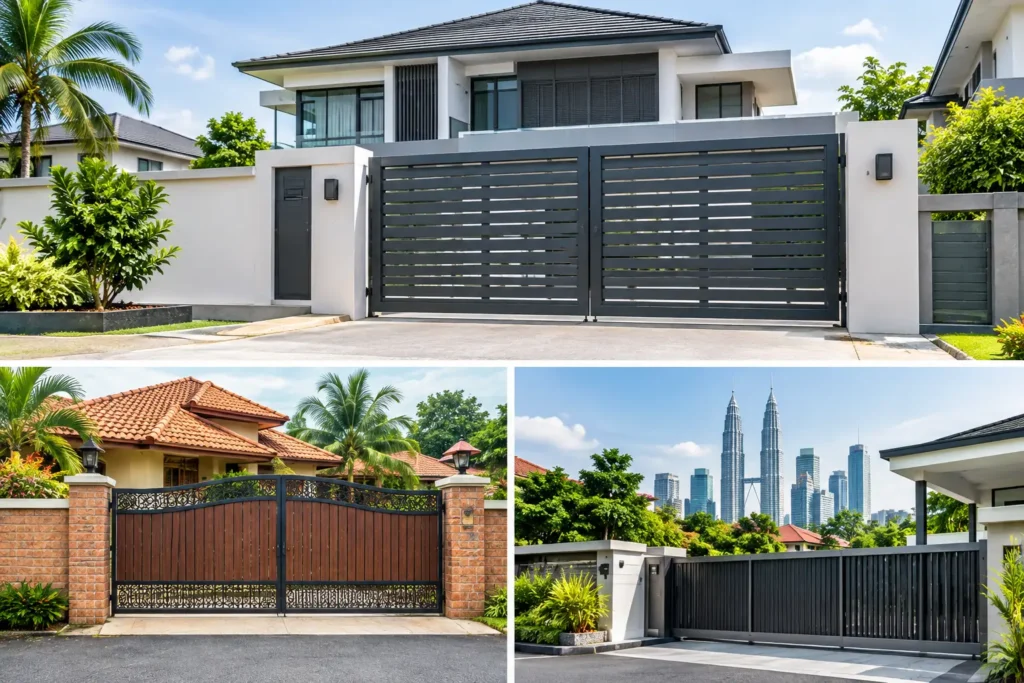
A gate can look perfectly proportioned at the factory and still become the weak point of a bungalow entrance once monsoon water runs across the driveway, the ground settles, or a heavy leaf meets a sloping approach. This residential gate selection guide focuses on the decisions that affect daily use: structure, movement, privacy, security, and the site conditions that a finished gate must handle in Puchong, Bangsar, Damansara Heights, and other Klang Valley neighborhoods.
A residential gate is not an isolated decorative panel. It is a moving architectural structure connected to posts, hinges or trackless mechanisms, electrical provisions, driveway levels, boundary walls, and the way vehicles enter the property. Selecting it well begins with the opening and the site, not a catalog image.
Start With the Entrance Layout and Site Conditions
The driveway width, available side clearance, road position, and gradient determine which gate configuration is practical. A wide, level frontage may suit a double-leaf swing gate. A narrow approach with limited internal clearance may be better served by a sliding or trackless gate. For a steep driveway, the leaf movement and bottom clearance need careful planning so the gate does not conflict with the finished surface.
Drainage deserves equal attention. In Malaysia’s heavy rain, water should not pond beneath the gate line or run toward the house. The driveway finish, drain position, threshold levels, and gate clearance should be reviewed together. A well-planned entrance uses appropriate ground levels and drainage paths rather than relying on excessive gaps beneath the gate, which can reduce privacy and security.
Site access also matters before fabrication begins. A landed property in TTDI or Bukit Tunku may have constrained roads, mature landscaping, or existing walls that influence delivery and installation sequencing. Measurements should cover more than the clear opening. The fabricator needs to assess column condition, wall alignment, driveway fall, access for lifting, and the position of any pedestrian gate, intercom, or lighting.
Gate Types: Match Movement to the Property
Swing Gates for Formal Frontages
Swing gates suit classic homes, courtyard entrances, and properties where the gate can open inward without affecting vehicle movement. They can be fabricated as single or double leaves, with proportions tailored to a modern bungalow facade or a more ornamental elevation.
Their main consideration is load. Long or heavy leaves place continuous force on hinges, posts, and fixing points. The supporting steelwork must be sized for the gate weight and opening cycle, while hinge alignment must keep the leaves level and prevent uneven gaps. A decorative gate is only as dependable as the structural support behind it.
Sliding and Trackless Gates for Driveway Efficiency
Sliding gates are often selected where the driveway needs to remain clear or where a swing arc would be impractical. A conventional sliding arrangement requires sufficient run-back space along the boundary. Trackless gates reduce the need for a ground track across the driveway, which can be useful where leaf debris and rainwater are concerns.
Trackless systems still require disciplined engineering. The supporting frame, cantilever arrangement, guide posts, stopping points, and base foundations must work as one system. If the gate is too heavy for its span or insufficiently braced, movement and alignment can suffer over time. For large openings in Putrajaya, Cyberjaya, or newer bungalow developments, the frame design should be considered alongside wind exposure and the visual weight of the cladding.
Folding Gates for Limited Side Space
Folding configurations can reduce the space required when opening, particularly where a conventional sliding run-back is unavailable. They are appropriate for selected entrances, but the multiple connection points and folding geometry demand precise fabrication and installation. This is not a place to compromise on frame alignment, hinge placement, or stopping positions.
Material Choice Is About More Than Appearance
Hot-forge solid wrought iron remains a strong choice for homeowners seeking a substantial, architectural entrance with shaped scrollwork, forged details, and a traditional grand presence. It is especially suited to luxury residences that require a gate with depth rather than a flat, repetitive pattern. The steel frame and ornamental components should be designed as a complete assembly, with welds, bracing, and finishing considered from the start.
For a more contemporary facade, laser-cut steel panels can create controlled privacy with geometric, botanical, or linear patterns. The panel design must retain enough open area or structural reinforcement to manage wind pressure and avoid excessive weight. A fully solid gate can look impressive, but it catches more wind and may require a heavier support system than a perforated design.
Aluminum is another option for homeowners who want a lighter visual profile and corrosion-resistant powder-coated finish. It works well with modern aluminum windows, slim-profile aluminum glazing, and louvers where the house design calls for consistent lines and color. The frame construction still matters. A large aluminum gate needs suitable internal reinforcement and properly designed connections, not simply thicker-looking sections.
Stainless steel is usually best used selectively as an accent, handhold, trim, or feature within the overall gate composition. Where exposed stainless steel is specified, grade 304 stainless steel is a common architectural option for appropriate applications. Material selection should reflect the design, exposure, cleaning access, and relationship to the rest of the facade.
Privacy, Security, and Street Presence Need Balance
A gate can provide privacy without becoming visually heavy. Vertical bars, layered laser-cut screens, louvered infills, and selective solid panels each create different sightlines from the street. The right answer depends on whether the homeowners prioritize an open garden view, a more private forecourt, or a formal statement at the boundary.
Security begins with geometry and construction. Gaps, frame joints, locking zones, pedestrian access, and the connection between gate and boundary wall should be assessed as a system. Multi-point security locking can be considered for the pedestrian gate, while the main gate structure needs a stable closing position and accurate latch alignment. Decorative elements should not create easy footholds or unnecessary access points.
For homes with glass-heavy facades, the gate design should complement rather than compete with the architecture. Slim-profile aluminum glazing, glass railings, and a dark powder-coated gate can create a clean, restrained frontage. A more traditional house may carry hot-forge wrought iron detailing through the main gate, window grilles, and staircase railing for a consistent result.
The Residential Gate Selection Guide to Structural Details
A gate’s visible design is only one layer of the specification. Ask for clarity on the main frame sections, infill material, post design, bracing, welding, corrosion protection, finish, and the fixing method into the wall or foundation. These details determine whether the gate remains straight, closes correctly, and carries its own weight without transferring avoidable stress into the boundary structure.
For steel gates, welded joints should be properly positioned and finished, while hollow sections need suitable treatment and drainage consideration to avoid trapping moisture. Posts must be aligned before final fixing. A gate that starts out even but is installed against an out-of-plumb post will show its problem at the latch line first.
Automation provisions should be coordinated early, even when the gate is fabricated as a manual installation initially. Cable routes, motor locations, stopping points, photocell positions, and manual release access affect the final frame and driveway layout. Retrofitting these decisions after installation often produces exposed conduits or awkward modifications that detract from the entrance.
Fabrication and Installation Should Be One Coordinated Scope
Custom gates perform best when design, fabrication, supply, and on-site installation are handled as a connected process. A site measurement informs the shop drawings and frame sizing. Fabrication then follows the agreed dimensions and details, while installation addresses the actual wall condition, levels, and alignment on site.
Home Alloy Design & Engineering Work provides new custom gate fabrication and turnkey installation from Puchong, Selangor, combining wrought iron, structural steel, laser-cut panels, and architectural metalwork according to the property requirements. For an entrance renovation or a new residence, the objective is not merely to fill an opening. It is to create a gate that belongs to the house, moves correctly, and withstands tropical exposure.
Frequently Asked Questions
What affects the investment required for a custom residential gate?
The opening width, gate type, structural frame, chosen material, decorative complexity, surface finish, site access, foundation or post requirements, and automation provisions all affect the final scope. A site review and confirmed design are needed before fabrication can be properly specified.
Is hot-forge wrought iron suitable for a modern residence?
Yes. Hot-forge solid wrought iron can be designed with restrained lines, simple verticals, or selected forged details rather than elaborate ornament. Its weight and depth can give a modern bungalow entrance a more substantial architectural presence when balanced with clean wall finishes and glazing.
Can a gate be fabricated to suit an existing boundary wall?
Yes, provided the existing wall, columns, and fixing areas are assessed for alignment and structural suitability. Where the supports are not adequate for the selected gate design, additional structural steel framing or revised support details may be required.
Which areas are covered for custom gate projects?
Home Alloy serves Puchong, Selangor, Kuala Lumpur, and surrounding areas including Subang Jaya, Petaling Jaya, Shah Alam, Bangsar, TTDI, Putrajaya, Cyberjaya, Kajang, Seri Kembangan, and Cheras, subject to project requirements and site review.
A well-selected gate should feel settled from the first day: proportionate to the facade, firm at every closing point, and prepared for rain, heat, and daily movement. Send your project details on WhatsApp, including the location, measurements, photos, drawings, and required items, and our team will review the requirements and advise on the next step.