
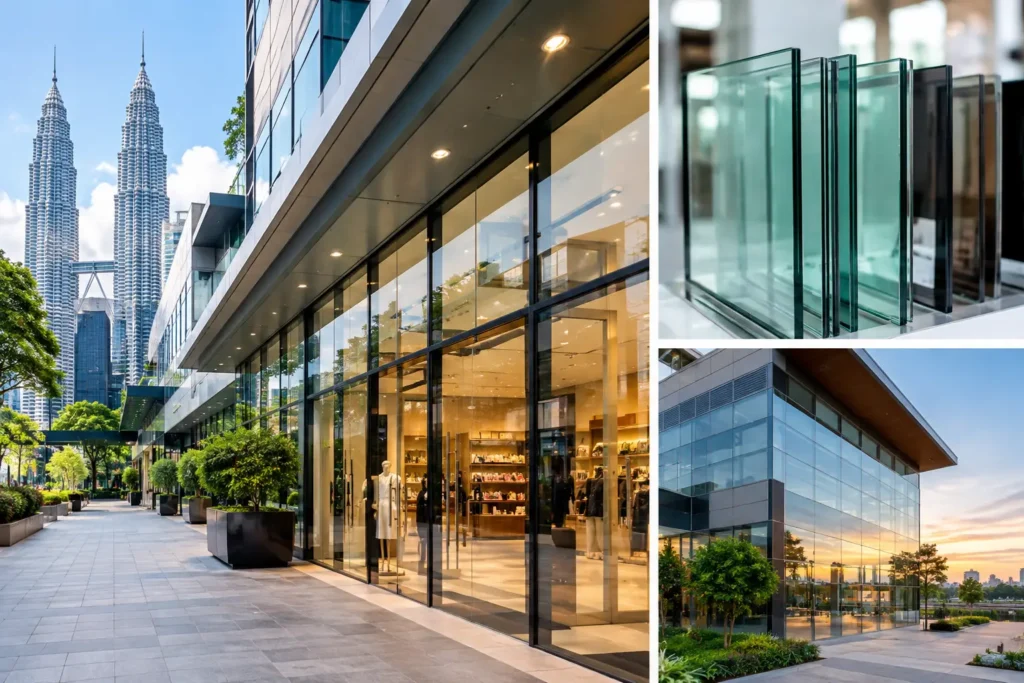
A street-facing shopfront in Puchong takes the full force of afternoon solar heat, heavy monsoon rain, and daily public traffic. Choosing between shopfront glass types is therefore not only a design decision. The selected glass, aluminum framing, door hardware, drainage details, and fixing method must work together to keep the entrance secure, clear, and properly aligned over time.
For retail lots, offices, showrooms, and commercial buildings across Selangor and Kuala Lumpur, the right specification depends on frontage size, exposure, tenancy use, security requirements, and the look of the interior. A full-height clear-glass facade may suit a premium showroom, while a food outlet or busy public-facing unit may need a more safety-focused combination.
Shopfront Glass Types and Where They Fit
Most commercial shopfronts use safety glass rather than ordinary float glass. Safety glazing is designed to reduce the risk of dangerous breakage in doors, low-level panels, and high-traffic areas. The two main options are tempered glass and laminated glass, although insulated glass units and decorative finishes can be added where heat control or privacy matters.
Tempered glass for clean retail frontage
Tempered glass is heat-treated to improve its strength compared with standard glass. When it breaks, it generally fragments into small pieces rather than long, sharp shards. This makes it a common choice for frameless swing doors, aluminum-framed entrances, sidelights, and fixed display panels.
Its clean appearance is a major advantage. Clear tempered glass gives fashion stores, galleries, salons, and corporate offices an open frontage with strong product visibility. It also works well with powder-coated aluminum framing in black, bronze, gray, or custom finishes.
The trade-off is post-processing. Once tempered, glass cannot be cut, drilled, or altered on site. Door pull handles, patch fittings, floor springs, locks, and pivot locations must be finalized during fabrication. Accurate site measurement before production is not optional, especially in older shop lots where walls and floor levels may not be perfectly square.
Laminated glass for retained protection
Laminated glass consists of two or more glass layers bonded with an interlayer. If a panel is damaged, the interlayer helps retain the broken pieces in position. This characteristic makes laminated glass a strong consideration for commercial entrances where security, impact retention, or overhead glazing performance needs closer attention.
For a shopfront facing a busy walkway in Subang Jaya or Shah Alam, laminated glass can provide added reassurance where accidental impact is more likely. It can also support acoustic improvement when the glass build-up and frame system are specified correctly.
However, laminated glass is heavier than a single tempered panel. The aluminum sections, transoms, anchors, and structural support behind the facade must suit the glass weight and panel dimensions. A large pane is not simply a larger version of a small pane. Deflection, load paths, edge support, and wind exposure need to be considered before fabrication starts.
Insulated glass for solar heat control
In west-facing commercial units, solar heat can quickly turn a glass-fronted space into an uncomfortable working environment. Insulated glass units use two panes separated by a sealed air or gas space. Combined with suitable coatings or tinted glass, they can reduce heat transfer and glare while maintaining a polished facade.
This option is more relevant for air-conditioned showrooms, offices, and premium developments in areas such as Bangsar, Putrajaya, and Cyberjaya. It is also useful where a facade has broad, uninterrupted glass areas that receive direct afternoon sun.
Insulated glazing adds thickness and weight, so it requires a compatible aluminum shopfront system. It is not suited to every narrow-profile frame. The perimeter seals and glass dampening gaskets must also be installed carefully to protect the sealed unit and maintain even pressure around the panel.
Tinted, frosted, and patterned glass
Clear glass is not the only commercial option. Tinted glass can soften glare and create a darker, more private appearance. Frosted or acid-etched finishes can screen meeting rooms, clinics, salons, and back-of-house areas while still allowing light through. Patterned glass offers texture and visual interest for brands that need a distinct frontage.
These finishes should be chosen with the interior lighting plan in mind. A dark tint may look premium from outside but can reduce natural light within the unit. Frosted sections are often most effective when limited to strategic zones rather than covering the entire facade. The goal is to balance privacy with visibility, not lose the commercial value of the storefront.
Glass Thickness Is Only One Part of the Specification
Clients often begin by asking for a thicker panel. Thickness matters, but it does not decide performance on its own. Panel width and height, glass type, frame depth, door operation, building movement, anchor fixing, and exposure all affect the final specification.
A framed fixed panel distributes loads differently from a frameless glass door. A tall entrance door with a floor spring needs correct top and bottom support, controlled clearances, and properly positioned hardware. An aluminum shopfront with multiple glass bays needs straight mullions, level transoms, and consistent joint lines, or even premium glass will look poorly executed.
At Home Alloy Design & Engineering Work, shopfront fabrication is approached as a complete assembly: made-to-order aluminum framing, selected glazing, door configuration, hardware coordination, and professional on-site installation. This is particularly relevant for renovation sites in Petaling Jaya, Puchong, and Kuala Lumpur, where existing columns, tiled floors, ceilings, and signboard zones can affect the final layout.
Framed or Frameless Shopfronts?
A framed aluminum shopfront gives the glazing defined edges and a more controlled structural grid. It is practical for larger openings, multi-panel facades, and projects requiring strong integration with hinged, sliding, or commercial entrance doors. Powder-coated aluminum also handles Malaysia’s wet and humid conditions well when fabrication, drainage, and installation details are correctly managed.
Frameless glazing creates a lighter visual effect. It is often selected for boutique entrances, offices, and internal commercial partitions where minimal visible aluminum is preferred. Yet a frameless look still relies on carefully selected glass thickness, patch fittings, floor springs, locks, and solid fixing points. It should not be selected purely for appearance without reviewing the opening and daily operating requirements.
For some projects, the best answer is a hybrid design: slim-profile aluminum framing around fixed panels, paired with a frameless tempered-glass door. This retains the visual openness of glass while giving the overall facade a clearer installation line and stronger perimeter control.
Rain Management Matters on a Malaysian Shopfront
Water entry is frequently a detailing issue rather than a glass issue. During monsoon conditions, wind-driven rain can reach joints, door thresholds, frame corners, and gaps between the facade and surrounding wall. A shopfront needs appropriate sill design, sealed perimeter joints, weep paths, monsoon drip channels where required, and correct flashing coordination with adjacent ACP awnings or facade finishes.
The installation team must check that water is directed outward rather than trapped within the frame. If the external pavement slopes toward the entrance, threshold and drainage planning become even more critical. This is why site inspection and measured fabrication should happen before aluminum sections and glass panels are produced.
Selecting Glass by Business Use
A showroom usually benefits from maximum transparency, so clear tempered glass or a laminated safety configuration may be suitable depending on panel size and security needs. Office frontages may use clear glass with frosted sections for meeting rooms. Food and beverage outlets often need glazing that works alongside awnings, signage, and frequent door movement. High-end retail spaces may combine low-visibility slim-profile aluminum glazing with tinted or laminated panels to maintain a refined appearance.
There is no single best shopfront glass type for every commercial unit. The correct choice comes from matching the glass system to actual site conditions, not copying the frontage next door.
Frequently Asked Questions
Which shopfront glass is best for security?
Laminated safety glass is often considered where retained protection after breakage is a priority. The right choice still depends on panel size, framing, locking arrangement, door hardware, and the overall entrance design.
What affects the cost of a custom glass shopfront?
Glass type and thickness, aluminum profile, opening size, door configuration, hardware, access conditions, structural support, and site installation requirements all affect the final project cost. A measured site review is needed for an accurate quotation.
Can a shopfront include slim-profile aluminum framing?
Yes. Slim-profile aluminum glazing can be used where the opening size, glass specification, and required structural performance are suitable. It is commonly selected for modern offices, showrooms, and premium retail facades.
Does Home Alloy handle fabrication and installation?
Home Alloy Design & Engineering Work provides new custom fabrication, direct supply, and turnkey installation for aluminum shopfronts and glass systems serving Puchong, Selangor, and Kuala Lumpur project locations.
A good shopfront should make the business visible, protect the entrance, and hold up through years of daily use and tropical weather. Send your project location, measurements, photos, drawings, and required items on WhatsApp, and our team will review the requirements and advise on the next step.