
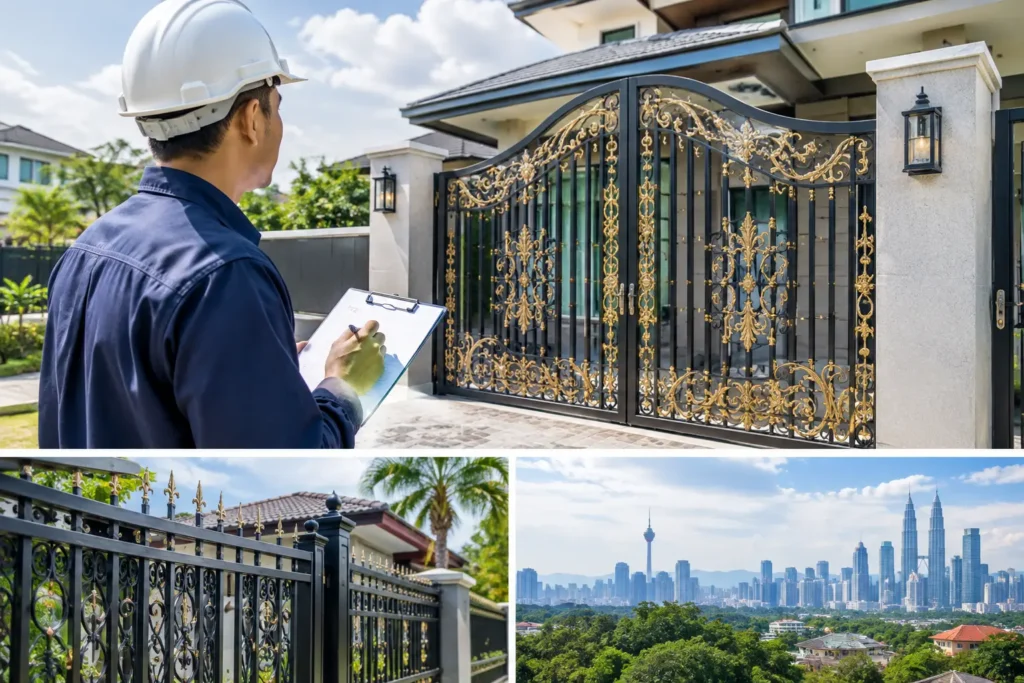
A main gate in Puchong can face hard afternoon heat, heavy monsoon rain, and repeated daily movement at the same time. That is why an ornamental gate contractor review should look beyond decorative patterns or a gallery photo. The real question is whether the contractor can turn an architectural concept into a correctly sized, properly supported gate that opens cleanly, protects the property, and remains visually balanced after installation.
For bungalows in Bangsar, Damansara Heights, TTDI, Putrajaya, and other Klang Valley neighborhoods, a gate is often the first major feature people notice. It should suit the house facade, provide the required privacy, and carry its own weight without placing unnecessary stress on the posts, track, hinges, or automation provisions. These are fabrication and site-execution matters, not just design preferences.
What a Strong Ornamental Gate Contractor Review Should Cover
A useful review of a gate contractor starts with evidence of project understanding. Custom ornamental gates are not off-the-shelf items. The opening width, driveway slope, existing columns, vehicle access, desired privacy level, and gate movement all influence the final fabrication.
A contractor should discuss the proposed gate type early. A pair of swing leaves has different loading and clearance requirements from a modern trackless sliding gate. A wide sliding gate needs a stable support arrangement and accurate alignment, while a swing gate requires hinge positions and post strength that can carry the leaf weight over time. Where the property has an uneven driveway or limited side clearance, the operating method can change the entire design approach.
The review should also reveal whether the contractor is comfortable with made-to-order work. Ornamental details must be scaled to the gate size. A dense floral pattern that looks refined on a drawing can become visually heavy across a broad frontage. Conversely, oversized scrollwork may overpower a compact entrance. Good fabrication balances the pattern, frame proportions, infill spacing, and sightlines from the street.
Look Past the Surface Finish
A newly painted gate can look impressive on installation day. Long-term performance is usually determined by the metalwork underneath. Ask whether the design uses hot-forge solid wrought iron where the project calls for traditional ornamental depth and hand-worked character, or whether a cleaner contemporary language is better achieved with steel framing, laser-cut panels, or a mixed-material composition.
Hot-forge solid wrought iron is especially suitable for grand entrances, palace-inspired gates, curved motifs, and substantial decorative elements. Its appeal comes from the forged texture, shaped scrolls, collars, and dimensional form that flat flat-bar imitations cannot fully reproduce. It is not automatically the right answer for every home, however. A minimalist house in Cyberjaya may call for simpler linear steelwork, aluminum features, or laser-cut privacy screens rather than a heavily ornamental design.
Material thickness and frame sizing matter because decorative components still transfer load into the main structure. The outer frame, internal bracing, hinge plates, and fixing points must work together. A gate with substantial forged work but inadequate bracing may twist or sag. A contractor should be able to explain where the load travels and why particular members, welds, and supports are specified.
Welding quality deserves close attention as well. Clean welds are not merely cosmetic. They join the frame, ornaments, stiffeners, and mounting plates into one stable assembly. Poorly planned joints can trap water, create uneven surfaces, or weaken a corner that receives repeated movement. For exposed sites in Shah Alam or Subang Jaya, details that allow water to drain rather than collect inside sections are particularly valuable.
Site Measurement Is Part of the Product
The strongest contractor reviews often mention orderly site coordination because fabrication begins with reliable measurements. Before a custom gate enters production, the contractor should confirm the clear opening, column condition, driveway level, finished ground level, wall lines, and any conflict with drains, curbs, or existing landscaping.
This is where a stylish drawing meets real construction. A gate may appear centered from the road but need adjustment because one column is out of plumb, a drain cover falls within the movement path, or the driveway slopes toward the entrance. These conditions should be addressed before fabrication, not forced into place during installation.
For projects that combine gates with fencing, decorative window grilles, railings, or an ACP awning, alignment across the whole frontage matters. The gate pattern does not need to be identical to every other metal feature, but the material finish, line weight, and visual rhythm should feel intentional. A contractor that handles design, fabrication, supply, and installation can coordinate these points earlier instead of treating each item as an unrelated purchase.
Installation Tells You Whether the Contractor Plans Ahead
Transporting a large gate leaf into a landed property in Cheras, Kajang, or Seri Kembangan can require careful access planning. Narrow roads, finished paving, limited turning space, and occupied homes all affect delivery and installation sequencing. The contractor should assess these practical constraints rather than assuming the fabrication can simply be carried onto the site.
During installation, proper alignment is essential. The gate should sit at the correct level, maintain consistent gaps, move without binding, and meet the receiving point cleanly. For sliding configurations, the guiding and support arrangement must keep the gate running true. For swing configurations, hinges and stops must be positioned to manage the full weight and movement of each leaf.
If the entrance includes masonry columns, steel posts, or structural steel framing, the fixing method must match the supporting substrate. Decorative gates are frequently heavy, especially when they include solid forged elements, dense panels, or glazing. The supporting structure cannot be an afterthought. In some situations, a contractor may need to coordinate the gate with new steel posts or reinforced structural elements so the loads are carried safely.
Design, Security, and Privacy Must Work Together
An ornamental gate can be open and welcoming, highly private, or somewhere in between. The right decision depends on the street condition, house layout, and client preference. A home near a busy road may benefit from denser infill or layered laser-cut panels, while a landscaped property may prefer controlled openness that preserves views and airflow.
Security also involves more than a dramatic appearance. Frame rigidity, secure locking provisions, well-designed access points, and stable mounting contribute to real performance. Where the entrance connects to aluminum doors, slim-profile aluminum glazing, or glass partitions within the same project, the design language can remain coordinated without compromising the distinct technical requirements of each system.
Powder-coated finishes are widely selected for their clean appearance and suitability for exposed architectural metalwork. The color choice should consider the facade, maintenance expectations, and the visual effect of direct sunlight. Dark finishes can make ornate profiles look more defined, while lighter tones can soften a large frontage. The best option depends on the architecture, not a single trend.
Questions Worth Asking Before You Appoint a Contractor
A serious contractor should be ready to discuss the proposed design, material selection, fabrication method, installation sequence, and site constraints in clear terms. Ask to see whether the pattern will be custom fabricated for your opening, what structure supports the gate, where bracing is located, and how the gate movement will be checked on site.
You should also clarify the full scope. Some projects require only a new custom main gate, while others involve fence panels, railings, structural steel posts, or integrated privacy screens. Establishing the scope early helps prevent a mismatch between the architectural intent and the final installation.
FAQs
What areas can an ornamental gate contractor serve?
Home Alloy Design & Engineering Work is based at No. 7, Jalan BK 1/19, Bandar Kinrara 1, 47180 Puchong, Selangor, serving custom residential and commercial projects across Puchong, Selangor, and Kuala Lumpur, including locations such as Petaling Jaya, Putrajaya, Cyberjaya, Shah Alam, TTDI, and Bangsar.
What affects the quotation for a custom ornamental gate?
The main factors are gate size, movement type, pattern complexity, material selection, hot-forge work, frame and bracing requirements, site access, supporting posts, finishes, and installation conditions.
Is hot-forge solid wrought iron suitable for every gate?
No. It is well suited to detailed, traditional, and grand ornamental designs. Modern homes may be better served by cleaner steel profiles, laser-cut panels, or a mixed design with simpler lines.
Can a contractor fabricate the gate and complete the installation?
Yes. A full-service contractor can measure the site, fabricate the custom gate, coordinate supporting metalwork where required, deliver it, and complete professional on-site installation.
Why are structural requirements relevant to a decorative gate?
Every gate transfers weight and movement forces into hinges, posts, tracks, and fixings. Correct sizing, welding, bracing, alignment, and support design protect both operation and appearance.
The most worthwhile gate is one that still looks composed after daily use and severe weather, because its design was supported by sound fabrication from the start. Send your project location, measurements, photos, drawings, and required items on WhatsApp, and our team will review the requirements and advise on the next step.