Malaysia’s weather can be tough on external building features. In Puchong, Subang Jaya, Kuala Lumpur and across the Klang Valley, strong afternoon sun and sudden heavy rain can quickly expose a poorly designed external screen.
When choosing aluminium louvers, it is not enough to look at the blade design or colour. The louver needs to suit the opening, the amount of ventilation required, the direction of the wall, privacy requirements and the level of rain exposure.
For a bungalow, utility area, staircase, plant room, car porch or commercial building, the right aluminium louver should provide a good balance between ventilation, rain protection, privacy and appearance.
Start With What You Need the Aluminium Louvers to Do
Before choosing the louver design, decide what you actually need it for.
An aluminium louver may be used to:
- Improve ventilation
- Screen air-conditioning condenser units
- Ventilate a wet kitchen or service area
- Provide privacy
- Reduce direct sunlight
- Screen a car porch or side boundary
- Hide pipes, cables and mechanical equipment
- Give a finished architectural appearance to an open area
These requirements can affect the blade spacing, blade angle, depth and overall frame design.
For example, a more open louver arrangement allows better airflow, but it may provide less privacy and less protection against wind-driven rain. A closer arrangement with deeper blades can provide better screening, but it can reduce airflow and natural light.
This is why custom fabrication is useful. Instead of fitting a standard-size panel into every opening, the blade spacing, angle, frame depth and panel divisions can be made to suit the actual site condition. This is particularly useful where walls, beams, existing windows or service pipes make the opening irregular.site condition. This is particularly useful where walls, beams, existing windows or service pipes make the opening irregular. Pasted markdown
Consider the Location and Exposure
The same aluminium louver design may not work equally well at every location.
Before fabrication, consider:
- Which direction the wall faces
- How much afternoon sun reaches the opening
- Whether the area is exposed to wind-driven rain
- Whether the opening is sheltered or fully exposed
- How much privacy is required
- How much ventilation is needed
For example, an exposed external wall may require a deeper blade and closer blade spacing than a sheltered internal courtyard.
For areas such as mechanical rooms, bathrooms, wet areas and outdoor service areas, the louver needs to allow ventilation while reducing the chance of rain entering the opening.
The blade angle and overlap are important. The frame should also be designed so that water does not become trapped at the bottom of the louver.
Small details such as the sill, drainage path and drip arrangement can make a significant difference after the louver has been installed.
Fixed or Adjustable Aluminium Louvers?
There are different types of louver systems, and the right choice depends on how you intend to use them.
Fixed Louvers
Fixed aluminium louvers are commonly used for permanent external screens.
They have fewer moving parts and provide a consistent appearance. They are suitable for:
- Service areas
- Air-conditioning condenser screens
- Stairwell ventilation
- Car porch features
- Building facades
- Outdoor equipment enclosures
For many residential and commercial projects, fixed louvers are a practical choice because there is no need to regularly adjust the blades.
Adjustable Louvers
Adjustable louvers allow the blade position to be changed according to the required airflow and light.
They can be useful where the occupant needs greater control, but the operating mechanism adds more components to the system.
For an external installation, the blade connection, operating system and drainage details need to be properly considered so the louvers remain secure and aligned during long-term use.
Horizontal or Vertical Louvers?
Horizontal Aluminium Louvers
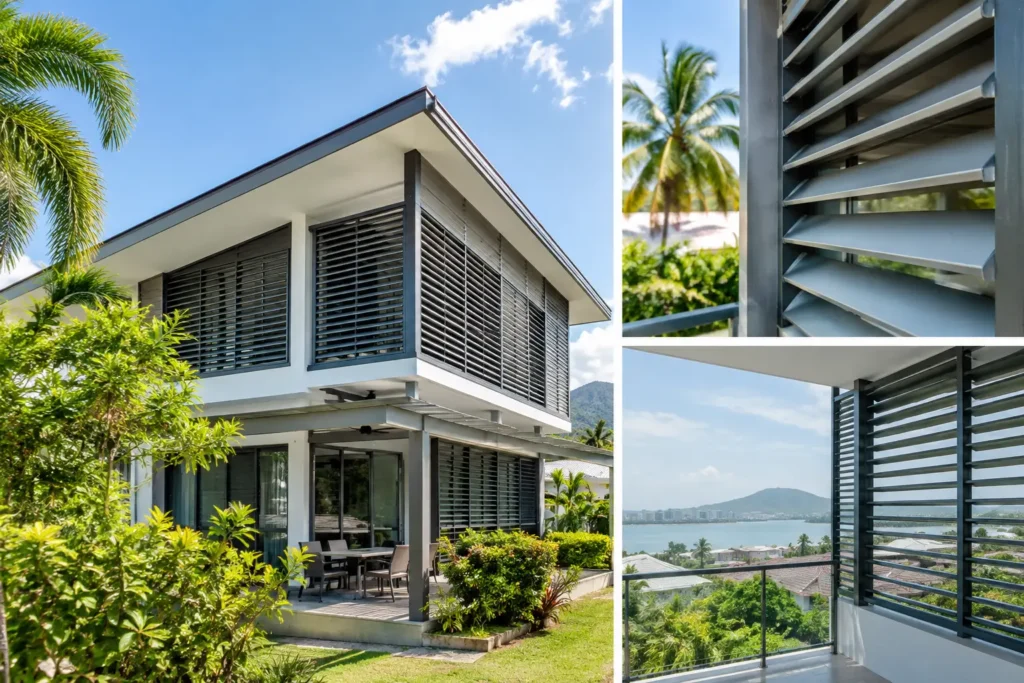
Horizontal blades are commonly used for external architectural screens.
They work well for:
- Utility areas
- Car porches
- Equipment screens
- Staircases
- Commercial facades
- Modern bungalow elevations
Their horizontal lines can also work well with aluminium windows, sliding doors and other horizontal elements of a building.
Vertical Aluminium Louvers
Vertical blades give the facade a different appearance and can provide stronger screening from certain side angles.
They are often considered where the architectural design calls for a taller or more vertical appearance.
However, the orientation alone does not determine rain protection. The overall blade profile, angle, spacing and weathering details still need to be considered.
The direction of the viewer’s sightline is also important. A privacy screen should be designed based on where people will actually be standing and looking from, rather than simply how it looks in an elevation drawing.
Aluminium Louver Options at a Glance
| Louver type | Main advantage | Common applications |
|---|---|---|
| Fixed horizontal | Good balance of airflow and screening | Service areas, car porches, facades |
| Fixed vertical | Strong architectural appearance and side-angle screening | Facades, boundaries, side walls |
| Adjustable | Allows control of airflow and light | Areas requiring adjustable ventilation |
| Deeper blades | Better screening and rain resistance | More exposed external areas |
| More open spacing | Better airflow and natural light | Well-ventilated service areas |
The final design should still be based on the actual opening, exposure and purpose of the installation rather than choosing a louver type from a catalogue alone.
Choose the Aluminium, Finish and Frame Carefully
The aluminium blades are only one part of the complete louver system.
The perimeter frame, reinforcement, fixing points and connection to the building are also important.
For larger openings, ask about:
- Aluminium blade thickness
- Blade profile
- Frame depth
- Reinforcement
- Panel width
- Fixing method
- Number of panel divisions
A long unsupported span can deflect, particularly when the louver is exposed to wind or installed at an upper level.
Instead of making one very large panel simply because it looks cleaner in a drawing, the panel divisions should be planned according to the opening and the required rigidity.
Powder-Coated Aluminium
Powder-coated aluminium is a practical choice for external applications in Malaysia.
It provides a consistent finish and is available in colours such as:
- Matte black
- Charcoal grey
- Bronze
- White
- Wood-grain finishes
Dark colours can provide strong contrast against glass, stone and ACP cladding, although dust and water marks may be more visible.
Lighter colours can show less surface marking and may be suitable where a softer appearance is preferred.
The choice should therefore consider both the building design and how much cleaning and maintenance the owner is comfortable with.
Pay Attention to the Fixings
Where aluminium louvers connect to steel, glass or other external hardware, the fixing materials should be suitable for the environment.
For exposed connections, corrosion-resistant stainless-steel fasteners can be considered.
A concealed fixing can give the louver a cleaner appearance, but the frame still needs proper structural anchoring behind the finished surface.
For larger or more exposed installations, the fixing method should be considered as part of the overall louver design—not as something to decide only during installation.
Check Rain Protection Before Fabrication
This is one of the most important parts of an external aluminium louver.
A louver may look good from the front but still allow too much rain through if the blade profile and angle have not been properly considered.
When reviewing a louver design, look at it from the side as well as the front.
The blade should encourage water to shed outward, while the frame should avoid creating areas where water can collect.
The existing building opening is also important.
An uneven concrete opening, poorly formed sill or missing flashing can affect the performance of the finished installation.
Louvers Around Awnings and Windows
Where aluminium louvers are installed near:
- ACP awnings
- Aluminium windows
- Aluminium doors
- Glass facades
- Other external glazing
the different systems need to be coordinated.
The louver frame should not block drainage from an adjacent window or glazing system.
Aluminium Louvers for Air-Conditioning Condenser Screens
Aluminium louvers are often used to hide outdoor air-conditioning condenser units.
However, the screen should not simply be made as dense as possible.
The condenser needs sufficient airflow to operate properly, and there should also be enough space for future servicing.
A louver that is too closed may restrict airflow.
A louver that is too open may leave the equipment, cables and piping unnecessarily exposed.
The design should balance:
Airflow + access + screening + appearance + rain protection.
Match the Louver Design to Your Building
Aluminium louvers should complement the building rather than look like an additional panel added afterwards.
For a modern house, slim horizontal blades can work well with:
- Aluminium casement windows
- Sliding doors
- Glass doors
- ACP cladding
- Modern metalwork
Wider blades can create a stronger architectural feature around a porch, balcony or staircase.
Vertical blades can also be used to create a taller visual appearance on a double-storey facade.
Another detail that makes a big difference is alignment.
Where possible, the louver divisions should line up with:
- Window mullions
- Door frames
- Tile joints
- Structural grid lines
- Other facade elements
When these lines are coordinated, the finished facade generally looks much more intentional.
Aluminium Louvers for Commercial Buildings
For commercial projects, aluminium louvers can be used to screen:
- Air-conditioning equipment
- Mechanical areas
- Service zones
- Plant rooms
- External equipment
The louver can hide these areas while still allowing the required ventilation.
It can also be designed to continue the visual lines of a shopfront, glazing system or other metalwork so that the equipment area does not look like an afterthought.
Why Site Measurement and Fabrication Matter
For custom aluminium louvers, accurate measurement is important.
Before fabrication, the contractor should check:
- Actual opening dimensions
- Wall condition
- Beam and column locations
- Existing windows and doors
- Pipes and cables
- Fixing positions
- Required panel divisions
- Access for installation
A panel that is slightly out of square can become very noticeable when several panels are installed side by side along a long facade.
For this reason, fabrication drawings and proper site measurements should be completed before production.
Custom Aluminium Louvers in Puchong and Klang Valley
At Home Alloy Design & Engineering Work, we provide custom aluminium louver fabrication and installation together with aluminium glazing, structural steel and other architectural metalwork.
Based in Bandar Kinrara, Puchong, Selangor, we coordinate custom installations for residential and commercial projects across the Klang Valley.
For a louver project, we can work from your site dimensions, drawings and site conditions to determine the appropriate blade arrangement, frame design, panel divisions and installation method.
Instead of selecting a louver based only on a small colour sample or catalogue picture, ask your contractor to explain:
- What blade profile is being used?
- What aluminium thickness is proposed?
- How will the frame be supported?
- How will the louver be fixed?
- How will rainwater be managed?
- How will the panels be divided?
- Is there sufficient access for future maintenance?
These details can make a significant difference to the finished installation.
Frequently Asked Questions About Aluminium Louvers
What affects the cost of aluminium louvers?
The final cost depends on factors such as the opening size, blade profile, aluminium thickness, powder-coat finish, reinforcement, access conditions and installation complexity.
Curved walls, upper-floor installations, integrated glazing and heavy-duty screening requirements can also affect the quotation.
What finish is suitable for external aluminium louvers in Malaysia?
Powder-coated aluminium is commonly used for external applications because it is suitable for exposure to sun, humidity and rain.
The final colour and finish should also take into account the building design, cleaning requirements and exposure to afternoon sun.
Can aluminium louvers be installed outside Puchong?
Yes. Home Alloy can arrange custom louver fabrication and installation for projects in areas such as Petaling Jaya, Shah Alam, Putrajaya, Cyberjaya, Kajang, Seri Kembangan, Ampang, Cheras, Bangsar and other Klang Valley locations, subject to the project and site requirements.
Can aluminium louvers be combined with other building features?
Yes. Aluminium louvers can be coordinated with ACP awnings, aluminium doors and windows, glass partitions, steel structures, laser-cut panels and other architectural metalwork.
When several elements are fabricated and installed under one scope, the junctions and finished lines can be coordinated more easily.
Need Aluminium Louvers for Your Project?
Every building has different site conditions, so there is no single louver design that is suitable for every opening.
If you are planning aluminium louvers in Puchong, Selangor or the Klang Valley, send us your site photos, drawings and approximate dimensions through WhatsApp.
We can review the opening and discuss the suitable louver arrangement, fabrication and installation requirements for your project.
WhatsApp Home Alloy Design & Engineering Work for a custom aluminium louver quotation and site assessment.