
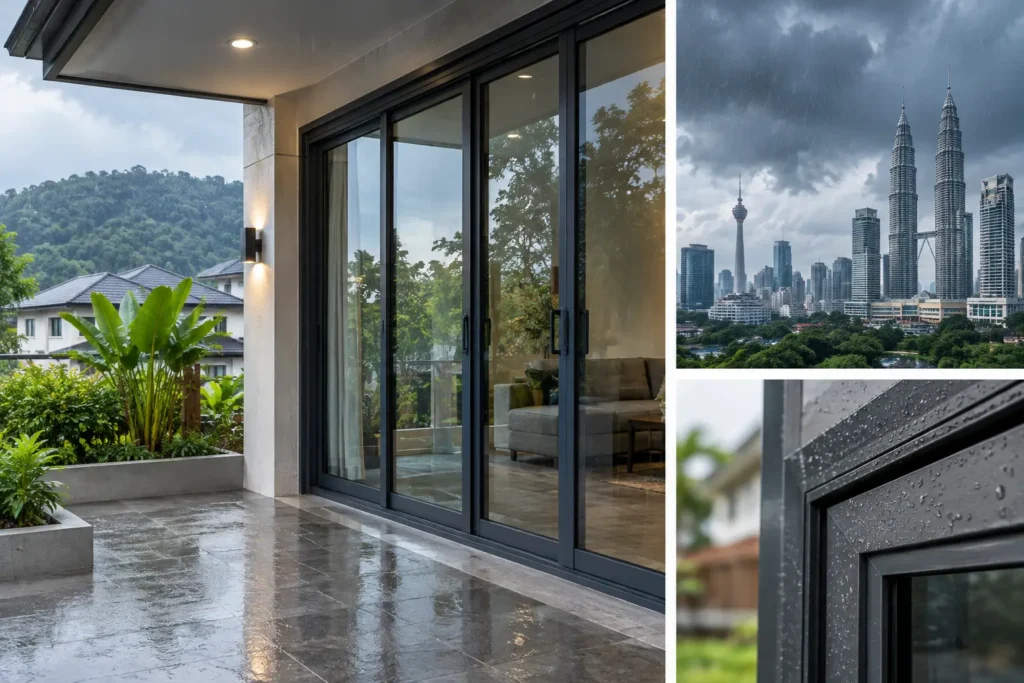
A sliding door can look perfectly aligned on a dry afternoon, then reveal its weak points during a Puchong downpour. Rain driven sideways by wind does not only hit the glass. It finds poorly sealed frame joints, shallow bottom tracks, unprotected screw points, uneven thresholds, and gaps between the frame and wall.
So, can aluminum doors resist monsoons? Yes, when they are specified, fabricated, and installed as a complete weather-management system. Aluminum itself handles Malaysia’s wet tropical climate well. The real difference lies in the profile design, glazing method, drainage route, perimeter sealing, structural fixing, and site alignment.
For homeowners planning a new extension, a slim-profile opening to the garden, or folding doors for a covered patio, the question should not be whether aluminum is waterproof by nature. The better question is whether the selected door system is suitable for the amount of wind and rain exposure at that particular elevation.
Can Aluminum Doors Resist Monsoons Under Driving Rain?
Powder-coated aluminum does not rust in the way untreated mild steel can. This makes it a strong choice for exterior casement, sliding, folding, and hinged door systems across the Klang Valley. With the correct coating finish and properly separated compatible materials, an aluminum frame remains stable and presentable through repeated wet and dry cycles.
However, no exterior door should be described as rainproof without qualification. A sheltered side entrance in Subang Jaya faces a very different condition from a wide rear opening on a bungalow in Bangsar or a high-level balcony door in Cyberjaya. Wind pressure can force water toward joints and tracks that would remain dry under ordinary rainfall.
A properly specified aluminum door controls this water in layers. Exterior-facing glass dampening gaskets form the first barrier. Interlocking sash profiles and compression seals form the next. Monsoon drip channels and weep paths then collect any water that enters the controlled drainage zone and direct it safely outward. This is why profile selection matters as much as the visible frame width.
The Frame Is Only One Part of Monsoon Performance
A premium aluminum profile cannot compensate for unsuitable glass, weak hardware, or poor installation. Each part has a job, and a failure at one point can affect the whole opening.
Profile depth and door configuration
Slim-profile aluminum glazing gives a clean architectural look, especially for modern homes in Damansara Heights, TTDI, and Putrajaya. Yet slim sightlines must still be supported by adequate profile depth, internal reinforcement where required, and hardware suited to the panel size and glass weight.
A large sliding panel places its load on the bottom track and roller system. A folding door transfers weight through its top and bottom hardware while each leaf must remain aligned. Casement doors rely on hinges, friction stays, compression seals, and a secure closing line. The correct configuration depends on opening width, panel height, exposure, roof overhang, and the way occupants intend to use the space.
For a highly exposed opening, a hinged or casement configuration with compression gaskets can offer a tighter weather seal than a basic sliding arrangement. That does not make sliding doors unsuitable. It means the sliding system needs deeper drainage provision, correctly designed interlocks, and accurate track installation.
Glass, gaskets, and glazing support
Glass is not simply placed into an aluminum frame and sealed around the edges. Its thickness and type must suit panel dimensions, wind exposure, safety requirements, and the selected aluminum system. The glazing blocks beneath the glass are equally important because they support the panel load and maintain the intended clearance within the sash.
Quality glass dampening gaskets keep the glass positioned while helping control water and movement. If gaskets are cut inaccurately, stretched at corners, or improperly seated, water can bypass the intended barrier. Silicone application also needs clean surfaces, compatible materials, correct joint depth, and a continuous finish. More sealant is not always better. Water must still be able to reach the drainage route designed into the system.
Drainage channels must remain functional
Most performance aluminum sliding systems are designed on the principle that some water may enter the outer track during severe rain. The critical requirement is that it drains outward, rather than overflowing into the interior.
This is where monsoon drip channels, sill design, weep holes, and threshold levels need close attention. A bottom track installed level in the wrong direction, blocked drainage outlets, or a finished floor that sits too high against the frame can trap water. On terrace homes and ground-floor extensions, external paving, drains, and awning coverage should also be considered before the door opening is fabricated.
Installation Quality Decides Whether the System Performs
At site, the door frame must be set square, plumb, and level before glass panels and hardware are adjusted. Even a quality custom-made door can perform poorly when the opening is out of square or when the frame is forced into position to follow an uneven wall.
Proper fixing transfers wind loads from the frame into the surrounding structure. The number and placement of anchors, the substrate condition, and the spacing at frame edges all matter. A new masonry opening, structural steel framing, or an extension wall may each require a different fixing approach. The frame should be supported without distortion so that sliding panels run correctly and closing gaskets meet evenly.
Perimeter gaps are then sealed as part of the building envelope. The installer must account for minor movement between aluminum, concrete, brickwork, and steel. A rigid, poorly prepared joint can crack or pull away over time, particularly where sun exposure and heavy rain repeatedly change surface temperatures.
For new openings below an ACP awning or adjacent to PU metal deck roofing, the upper junction deserves special attention. Water from a roof edge must be directed away from the door head rather than allowed to discharge onto the glazing line. Good drainage planning protects both the door and the finishes around it.
What to Specify for an Exposed Exterior Door
For a new custom aluminum door, the project brief should identify the opening location, whether it is ground level or elevated, the amount of roof shelter, panel sizes, preferred operation, and the wall or structural steel condition. Photos, architectural drawings, and measurements help determine whether a standard-looking configuration is actually suitable for the site.
The most useful specifications are practical: powder-coated aluminum suited to exterior use, an appropriate profile series and wall thickness, safety glass selected for the panel size, properly designed drainage channels, quality gaskets, compatible sealants, and hardware matched to the door load. For security, multi-point security locking can be included where the configuration allows it, particularly on external hinged and casement doors.
A large garden-facing opening may also benefit from coordinating the aluminum door with the surrounding works. This could include an ACP awning to reduce direct rain exposure, a glass railing with correctly planned drainage, or structural steel framing for a wider span. These elements should be designed together, not treated as separate afterthoughts.
Custom Fabrication Is Better Than Forcing a Standard Size
Monsoon resistance is closely linked to fit. Made-to-order fabrication allows the frame, panel division, threshold detail, and fixing points to suit the actual opening rather than forcing a generic door into an irregular site condition.
Home Alloy Design & Engineering Work provides new custom fabrication, direct supply, and professional installation for aluminum doors, windows, glazing, structural steel, roofing, and architectural metalwork from Puchong, Selangor. For residential and commercial projects, the team can review the site condition before fabrication so drainage, alignment, hardware, and related steel or roof interfaces are addressed early.
Frequently Asked Questions
Are aluminum doors suitable for homes in Puchong and the Klang Valley?
Yes. Powder-coated aluminum doors are well suited to Malaysia’s wet, humid climate when the profile, glass, seals, drainage, and installation method match the site’s weather exposure.
What affects the quoted cost of a custom aluminum door?
The door type, opening size, aluminum profile, glass specification, hardware, locking requirement, finish, site access, structural conditions, and installation complexity all affect the final scope. A large folding or slim-profile glass door requires different engineering from a smaller hinged entrance door.
Can slim-profile aluminum doors handle heavy rain?
They can, provided the selected system is designed for exterior exposure and the panel sizes are within its intended performance range. Very exposed locations may need a deeper profile, stronger hardware, added shelter, or a different door configuration.
Can aluminum doors be installed within structural steel framing?
Yes. The steel frame must be correctly sized, welded, braced, and aligned before the aluminum frame is installed. Clear load paths and accurate opening dimensions are necessary to prevent distortion and maintain the weather seal.
Which areas do you serve for new aluminum door projects?
Projects are handled in Puchong, Selangor, and across the Klang Valley, including Subang Jaya, Shah Alam, Petaling Jaya, Putrajaya, Cyberjaya, Bangsar, TTDI, Kajang, and Seri Kembangan.
A door that performs through monsoon weather starts with a proper site review, not a guess based on appearance alone. Send your project location, measurements, photos, drawings, and required items on WhatsApp, and our team will review the requirements and advise on the next step.
