
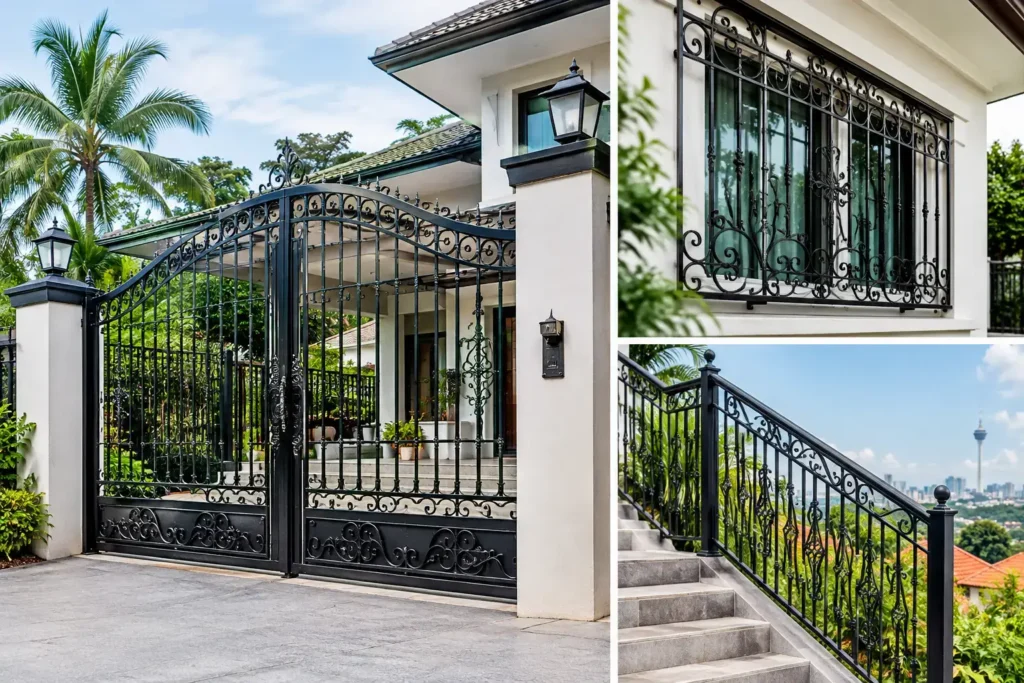
A main gate that faces afternoon sun, heavy rain, and constant vehicle access needs more than an attractive pattern. It needs properly sized steel members, clean welds, stable hinges, accurate alignment, and a coating system that can withstand Malaysia’s tropical climate. That is where custom wrought ironwork earns its place – combining security, privacy, and architectural character in one permanent feature.
For bungalows in Puchong, Bangsar, TTDI, and Damansara Heights, wrought iron remains a strong choice for entrance gates, perimeter fences, staircase railings, window grilles, and decorative panels. The best results do not come from choosing a design from a catalog alone. They come from matching the design to the building facade, opening size, site exposure, access requirements, and the weight that every post, hinge, and fixing must carry.
Why wrought ironwork still belongs in modern architecture
Wrought ironwork has a visual depth that slim aluminum and glass systems cannot always provide. A forged scroll, leaf detail, spearhead, or geometric bar catches light differently from flat sheet metal. It gives a gate or railing a sense of permanence, especially on classical residences, modern villas with warm stone finishes, and commercial entrances that need a more established presence.
However, ornate does not have to mean old-fashioned. Contemporary wrought iron designs often use straight vertical bars, restrained curves, laser-cut accents, or framed geometric motifs. A black powder-coated finish can make the work feel crisp and modern, while bronze, charcoal, or textured finishes can suit homes with timber, marble, or natural stone elevations.
The right style depends on the architecture. A large Bukit Tunku residence may suit a grand double-leaf gate with hot-forged ornamental details. A newer home in Cyberjaya may call for a cleaner trackless gate with selected forged elements rather than a fully decorative surface. The material can work across both directions when the proportions are controlled.
The difference between decorative metal and engineered ironwork
A gate is not simply a decorative screen on hinges. Its load travels from the gate leaves into the hinge plates, posts, base plates, concrete supports, and ground. If one part is undersized or poorly aligned, the gate can sag, drag, or place unnecessary stress on the operator system.
For custom fabrication, the frame size should suit the gate span and selected infill. Solid forged bars and dense ornaments add substantial weight compared with open, minimalist patterns. Larger openings may require reinforced framing, more capable hinge arrangements, central supports, or a sliding configuration. For a trackless system, wheel arrangement, guide positioning, opening clearance, and ground level all need attention before fabrication begins.
The same principle applies to staircase railings. The handrail, balusters, posts, and fixing plates must be proportioned for the stair structure and the intended use of the space. A grand staircase in a residence may use hot-forge solid wrought iron with a substantial handrail, while a commercial staircase may require a simpler steel railing designed around higher daily traffic and clear circulation.
Welding quality matters as much as member sizing. Neat, continuous welds at critical joints provide a cleaner finish and stronger connection than rushed tack welding. After fabrication, grinding and surface preparation affect whether the final coating looks smooth and whether it performs well outdoors.
Where hot-forged details make a difference
Hot-forge solid wrought iron is shaped under heat rather than merely bent cold from standard bar. It creates the hand-worked texture, tapered ends, hammered surfaces, and tighter ornamental forms associated with heritage-style gates and railings. This is particularly suitable for statement entrances, palace-inspired gates, spiral staircase features, and formal boundary fencing.
It is also a design decision with practical consequences. Forged details are heavier and take longer to fabricate than simple fabricated bar patterns. They are best used where their texture will be visible and valued – on a main gate, prominent balcony railing, entrance grille, or stair feature – rather than applied everywhere without purpose.
Specifying gates and fences for rain, heat, and privacy
Monsoon exposure is a real design condition in Selangor and Kuala Lumpur. Rainwater can settle in horizontal channels, open joints, and low points around gate frames. Fabrication should avoid water traps where possible, while posts and bottom rails need drainage considerations. At the installation stage, site levels and the fall of the driveway affect whether gate leaves maintain adequate ground clearance.
A coating system also needs to suit its location. Exterior wrought iron is typically prepared and finished for weather resistance, with a selected topcoat or powder-coated system based on the design and exposure. Dark finishes are popular, but they can show dust and water marks more readily on exposed frontages. Textured finishes may be more forgiving visually, while smoother finishes offer a sharper architectural appearance.
Privacy is another balance. Closely spaced vertical bars, solid laser-cut panels, and layered ornamental motifs reduce direct views into a property. Yet a fully closed gate increases wind pressure and can make a frontage feel heavy. Open ironwork allows airflow and visibility, but offers less screening. For many homes in Shah Alam or Putrajaya, a mixed design works well: a steel frame and selected solid panels at eye level, balanced with open sections above or below.
Railings, grilles, and glazing: designing the connections
Wrought ironwork rarely sits alone on a complete project. A staircase railing may meet glass panels, stone treads, timber handrails, or structural steel stringers. Window grilles may be positioned around powder-coated aluminum windows, where fixing locations must not interfere with frames, drainage paths, or glass dampening gaskets.
This is where an integrated fabrication approach helps. When the same project team understands aluminum glazing, structural steel framing, and ornamental metalwork, details can be coordinated before materials arrive on site. A decorative window grille can be designed with the glazing layout. A steel staircase structure can be fabricated to receive a wrought iron balustrade cleanly. An ACP awning or PU metal deck roof can be planned so runoff does not discharge directly onto a gate mechanism or railing.
For commercial properties, the visual language can carry through from a steel mezzanine floor or staircase to shopfront framing and internal glass partitions. The key is not to make every element ornate. Use wrought iron where texture, security, and visual presence are required, then let aluminum and glass bring lightness to the rest of the space.
What affects a custom wrought ironwork proposal
Every made-to-order gate, grille, or railing is influenced by its actual site conditions. The opening width and height, site access, existing structural supports, desired operating method, design density, and finish all affect fabrication scope. Photos, measured dimensions, elevation drawings, and inspiration references give the fabrication team a clearer starting point.
For a new residence, it is also useful to coordinate wrought ironwork after the relevant wall, column, stair, and driveway dimensions are confirmed. Installing a beautifully fabricated gate against unverified levels or incomplete supports creates avoidable alignment issues. For larger gates, staircase structures, and elevated railings, structural requirements should be reviewed as part of the overall project design.
Home Alloy Design & Engineering Work provides new custom fabrication, direct supply, and professional installation for wrought iron gates, fences, railings, decorative grilles, structural steel, aluminum systems, and architectural glazing from Puchong, Selangor.
Frequently asked questions about wrought ironwork
Is wrought ironwork suitable for contemporary homes?
Yes. Modern wrought ironwork can use clean-lined bars, restrained geometric patterns, framed panels, and dark powder-coated finishes. The design should follow the facade rather than defaulting to highly decorative motifs.
What is hot-forge solid wrought iron used for?
Hot-forged iron is suited to ornamental gates, staircase railings, formal fences, and statement features where hammered textures, scrolls, tapered ends, and traditional craftsmanship are part of the intended look.
Can wrought iron gates be combined with trackless gate systems?
Yes, provided the gate frame, weight, wheel system, guide arrangement, ground condition, and opening clearance are planned together. Heavier forged details require careful sizing and installation alignment.
Which areas does Home Alloy serve for custom ironwork?
The team serves residential, commercial, and industrial projects across Puchong, Selangor, and Kuala Lumpur, including areas such as Subang Jaya, Petaling Jaya, Shah Alam, Putrajaya, Cyberjaya, Cheras, and Bangsar.
What should be prepared before requesting a wrought ironwork proposal?
Provide the project location, approximate measurements, site photos, drawings where available, and the items required, such as a main gate, fence, grille, staircase railing, or decorative panel. This allows the team to assess design direction, access, fixing conditions, and fabrication requirements.
A well-designed iron gate or railing should feel like part of the building, not an item added afterward. Send your project details on WhatsApp and our team will review the requirements and advise on the next step.